







What is Auto Stamping?
Automotive stamping is the fundamental manufacturing process that transforms flat metal sheets into intricate, high-strength components essential for vehicle
construction. These parts range from structural frames and body panels to safety reinforcements and critical chassis elements. The automotive industry’s drive towards lighter vehicles, enhanced fuel efficiency, and improved crashworthiness has significantly elevated the complexity and precision required in stamping operations. This intricate field merges material science, mechanical engineering, and digital modeling to ensure the consistent production of millions of parts annually. Key materials utilized include mild steel, high-strength low-alloy (HSLA) steel, advanced high-strength steels (AHSS), and aluminum alloys, with occasional use of magnesium or hybrid composites. The selection of these materials profoundly impacts the design of the tooling, the required press force, the forming strategies, and the overall economic viability of the production process.
The Engineering Core: Dies
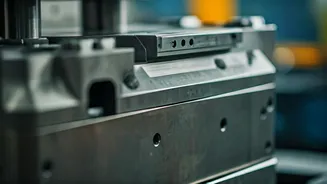
Stamping dies are the precision instruments that dictate the form, tolerance, and repeatability of every automotive component. These tools consist of upper and lower sections that are precisely mated within a stamping press. As sheet metal is fed between them, immense pressure is applied, forcing the material into the desired shape through cutting, bending, or drawing operations. For the high-volume demands of the automotive sector, dies must maintain their integrity and dimensional accuracy over millions of cycles. This necessitates the use of premium tool steels, sophisticated finishing techniques, effective cooling systems, and durable hard coatings. In automotive applications, several die types are commonly employed. Single-stage dies perform one specific operation per press stroke, suitable for simpler parts. Transfer dies move the workpiece between various stations on a press line to execute sequential forming steps. Progressive dies, however, are the workhorse for high-volume production; they perform multiple operations on a continuous metal strip as it advances through a series of die stations, significantly boosting productivity, minimizing handling errors, and reducing cycle times, making them ideal for producing components like brackets and small structural elements.
Die Design Precision
The meticulous design of automotive stamping dies lays the groundwork for successful manufacturing. This crucial phase, often employing advanced CAD/CAE software and finite element analysis (FEA), allows engineers to predict and mitigate potential issues like material flow problems, excessive thinning, wrinkling, and springback. Springback, the tendency of metal to partially return to its original shape after being formed, is particularly challenging with high-strength materials. Sophisticated simulation tools enable designers to precisely anticipate and compensate for this phenomenon during the die design phase, thereby avoiding costly rework and lengthy validation processes. Furthermore, digital twin technologies allow for the simulation of entire press line operations before physical tooling is even manufactured, accelerating the time-to-market for new vehicle models and reducing capital expenditure risks associated with prototyping and testing.
Stamping Press Technologies
The evolution of automotive stamping presses has transformed traditional press shops into highly integrated, intelligent manufacturing environments. Conventional mechanical presses, known for their high operating speeds, are well-suited for finer materials and less complex geometries. Hydraulic presses offer superior control, particularly for deep-drawing operations that require significant material deformation. However, the most significant technological leap has been the introduction of servo presses. These advanced machines feature programmable slide motion, allowing for optimized material flow, substantial energy savings, and enhanced forming accuracy. This programmability is especially beneficial when working with ultra-high-strength steels or aluminum panels, where precise control over the forming process is critical. Complementing these advanced presses are sophisticated automation systems, including robotic part handling and automated lubrication units, which further amplify productivity, improve worker safety, and reduce scrap rates.
Die Manufacturing & Materials
The creation of automotive stamping dies is a multi-faceted process demanding exceptional precision at every stage, often measured in microns. It begins with design validation through simulation, followed by precision CNC machining of die blocks. Subsequent steps include essential heat treatment and surface hardening processes to enhance durability. Assembly, rigorous tryout sessions, and meticulous dimensional inspection and correction are critical. Pilot production validation confirms the die's performance. Modern die manufacturing facilities leverage cutting-edge technologies such as five-axis CNC machining centers, wire electrical discharge machining (EDM), coordinate measuring machines (CMM), and laser scanning for precise geometric verification. The development and manufacturing lead time for intricate body panel dies can span 12 to 24 weeks, highlighting the necessity for strong strategic partnerships between automotive manufacturers and their tooling suppliers to meet demanding timelines, cost targets, and stringent quality benchmarks. The increasing use of advanced high-strength steels (AHSS) and press-hardened steels, vital for lightweighting and crash safety, presents unique forming challenges. Hot stamping, for instance, involves heating steel blanks before forming and cooling them within the die to achieve ultra-high strength, crucial for safety-critical areas like B-pillars. Similarly, the incorporation of aluminum requires careful management of its lower formability and tendency for increased springback.
Quality Control & ROI
Robust quality control is integrated throughout the high-precision metal stamping process for vehicle production. Real-time monitoring systems track parameters such as pressure, stroke uniformity, and material thickness. Advanced vision inspection systems are employed to detect surface imperfections, cracks, or deviations from specified dimensions. Statistical process control (SPC) tools analyze production data to proactively identify and prevent defects, thereby minimizing scrap. The integration of Industry 4.0 principles facilitates predictive maintenance, reducing unplanned downtime caused by tool wear or press misalignment. For business stakeholders, investment decisions in stamping technology are primarily driven by long-term return on investment (ROI). While the initial tooling costs, particularly for large body panel dies, can be substantial, the cost per part significantly decreases with higher production volumes. More sophisticated progressive die systems require a greater upfront capital outlay but deliver reduced cycle times and less reliance on manual labor. Profitability is further enhanced by optimizing material utilization, minimizing waste, and achieving energy savings. Advanced nesting and optimization software play a key role in reducing raw material consumption. In competitive sourcing environments, suppliers who embrace technological advancements and implement just-in-time production methodologies gain a distinct market advantage.
EVs & Future Trends
The rapid ascendance of electric vehicles (EVs) is reshaping stamping priorities, necessitating novel forming strategies for components like battery enclosures, motor housings, and specialized structural reinforcements. The growing use of aluminum and mixed-material structures demands new die finishes, advanced lubrication techniques, and innovative hybrid joining methods. As automakers transition to modular vehicle platforms, stamping flexibility and rapid tool-change capabilities are poised to become critical strategic differentiators. The future of automotive stamping technologies will be increasingly characterized by digitalization, a focus on advanced material development, and a strong emphasis on sustainability. The imperatives of lightweighting, achieving carbon neutrality, and supporting vehicle electrification are compelling manufacturers to re-evaluate traditional forming techniques. The widespread adoption of progressive simulation, AI-powered process monitoring, and modular die systems will further accelerate time-to-market and enhance product quality consistency. For both OEMs and their Tier 1 suppliers, strategic investments in precision automotive stamping and die technologies are no longer optional but are fundamental to maintaining competitiveness in the dynamic automotive landscape. The precision achieved in every stamped component is foundational to producing safe, lightweight, and technologically advanced vehicles.