







Pioneering Seamless Journeys
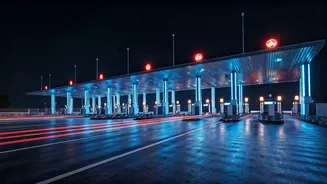
A significant advancement in Indian highway infrastructure has been unveiled with the operationalization of the country's inaugural barrier-free toll plaza.
Situated on the crucial Mumbai-Delhi National Highway (NH-48), specifically along the Kamrej-Choryasi stretch connecting Surat and Bharuch in Gujarat, this innovative facility aims to redefine the toll collection experience. Following an extensive two-month trial period that commenced on February 2, the Choryasi toll plaza is now fully functional. This groundbreaking system facilitates uninterrupted vehicle passage, a stark contrast to traditional toll booths, thereby alleviating traffic bottlenecks on one of the nation's most frequented arterial routes. The implementation is part of a broader modernization initiative by the Ministry of Road Transport and Highways, leveraging Multi-Lane Free Flow (MLFF) tolling technology, championed by the National Highways Authority of India.
Commuters Applaud Efficiency
Since the introduction of the FASTag-enabled barrier-free tolling system, highway users have overwhelmingly shared positive feedback, highlighting the tangible benefits of this advanced technology. Short video testimonials released by the Ministry of Road Transport and Highways showcase motorists expressing their satisfaction with the smooth and time-efficient travel afforded by the Multi-Lane Free Flow system. One regular commuter on this route emphasized the profound improvement in their daily travel, stating that the new setup has drastically cut down their transit time. Previously, crossing the toll plaza could take upwards of five minutes; now, this waiting period is entirely eliminated, leading to significant savings in both time and fuel consumption, a sentiment echoed by many who have experienced the upgraded facility.
Technology Behind the Flow
The magic behind the barrier-free toll plaza lies in its sophisticated technological integration. High-definition cameras strategically positioned on overhead gantries are responsible for capturing images of vehicle license plates. Concurrently, Radio-Frequency Identification (RFID) sensors diligently scan for FASTag information. Upon successful identification, the designated toll amount is automatically deducted from the user's linked bank account, eliminating the need for any manual transaction or driver interaction. A.R. Chitransi, Chief Operating Officer of NHAI, elaborated on this seamless process, explaining that vehicles can now pass under the gantry at normal driving speeds, with the toll processing occurring in the background. This 'multi-lane free-flow' approach ensures that vehicles do not need to stop, thus enabling continuous movement along the highway.
Speed, Safety, and Future
Officials have confirmed that this contactless tolling system is meticulously designed to significantly reduce the long queues and traffic jams that have historically plagued toll plazas. A remarkable aspect of this technology is that vehicles can maintain speeds of up to 80 kilometers per hour while passing through the toll point, ensuring uninterrupted traffic flow even during peak hours. For instances where a vehicle might not have an active FASTag, the system is equipped to identify the vehicle via its license plate and subsequently dispatches an electronic payment notification to the registered owner. This pilot project in Surat aligns with Union Road Transport and Highways Minister Nitin Gadkari's vision to transition towards a completely barrier-free toll collection landscape across India by the end of 2026.