







Understanding M1 Coaches
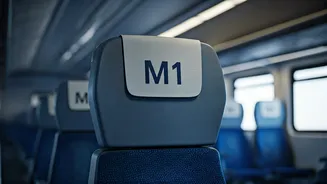
When you see an 'M1' marking on a train coach, it signifies Indian Railways' AC 3-tier economy class. These coaches are an evolution from previous designations
like B1 and B2 for AC 3-tier and S1 for sleeper coaches. The introduction of the M-series, particularly M1, aims to broaden access to air-conditioned travel by offering a more economical option. Predominantly found in modern LHB (Linke Hofmann Busch) coaches, which are lightweight and constructed from stainless steel based on advanced German technology, these coaches enhance train safety and allow for higher operating speeds. You'll frequently encounter them on extensive long-distance routes traversing key cities across India.
Key Differences Explained
The primary distinction between an M1 coach and a conventional AC 3-tier coach lies in their passenger capacity and cost. A standard AC 3-tier coach typically accommodates around 72 passengers, whereas an M1 coach is designed to seat approximately 83 passengers. This increased seating arrangement means more travelers can be accommodated on a single journey. In return for this denser configuration, M1 coaches generally offer ticket prices that are about 6-8% lower than regular 3AC. This makes the M1 coach a compelling choice for budget-conscious travelers seeking the comfort of air conditioning without the premium price tag.
Comfort and Amenities
While both M1 and regular 3AC coaches provide air-conditioned environments, there are subtle differences in comfort and amenities. Regular 3AC coaches tend to offer slightly more personal space and may include features like privacy curtains for an enhanced travel experience. M1 coaches, due to their higher density, can feel more compact, especially for passengers in the middle berths. However, these economy coaches are not stripped of essential conveniences. They are equipped with vital facilities such as charging points for electronic devices, individual reading lights, efficient fans, and of course, air conditioning. Basic amenities like toilets and bedding (provided on select services) are generally consistent across both types, though M1 coaches are characterized by their higher passenger occupancy rates.
Affordability and Accessibility
Indian Railways has strategically designed M1 coaches with the goal of making AC travel more affordable and accessible to a wider demographic. For individuals undertaking journeys between major cities, this translates into reduced travel expenses without compromising on the essential comfort of air conditioning. Students and working professionals, in particular, can achieve significant savings, potentially between Rs 300 and Rs 500 on each trip. Furthermore, the increased seating capacity in M1 coaches plays a crucial role in improving ticket availability, especially during peak travel seasons when demand is high, making it easier for more people to secure their travel plans.
Travel Savings and Booking
The economic advantage of opting for an M1 coach can be substantial, particularly for families or groups traveling together. For instance, on popular routes, choosing an M1 coach can lead to savings of Rs 1,000 to Rs 2,000 for a family, all while enjoying the benefits of AC travel. The booking process remains straightforward; passengers can easily identify M1 coaches by checking the coach type listed on the IRCTC app or website. As these coaches become increasingly integrated into the Indian Railways network, they are becoming a common sight on many of the nation's busiest and most frequented train services, offering a cost-effective travel solution.
Refunds and Future Outlook
When it comes to financial aspects, the refund rules applicable to M1 coach bookings are identical to those for other AC classes within Indian Railways. It is important to note, however, that once a ticket is booked, the coach type cannot be altered. Looking ahead, Indian Railways has indicated plans to expand the deployment of M-series coaches, including M1, across a greater number of trains. This strategic expansion signifies a continued commitment to enhancing travel accessibility. Ultimately, while M1 coaches significantly lower the cost barrier to AC travel, passengers embarking on very long journeys might still wish to carefully consider the trade-off between comfort and cost before making their booking.