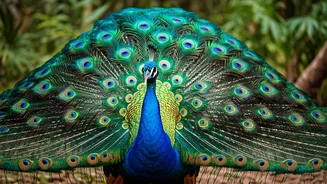

Peacock's Dazzling Display
The Indian peafowl, or peacock, stands as an epitome of avian beauty, primarily due to its resplendent plumage. The male peacock, renowned for its elaborate
tail feathers, utilizes this vibrant display to captivate potential mates. These feathers, adorned with iridescent 'eyes,' serve a crucial role in the peacock's mating rituals. The intricate patterns and shimmering hues are a result of microscopic structures within the feathers that manipulate light, creating a dazzling array of colors. Beyond attraction, the peacock's appearance also plays a role in intimidation, acting as a visual warning to potential rivals and predators. Their grand display can also signify health and genetic fitness, indirectly communicating the male's ability to survive and thrive. This serves to increase the chances of reproduction by attracting the females.
Clownfish: Underwater Rainbow
The clownfish, celebrated for its vibrant orange and white stripes, thrives amidst the protective embrace of sea anemones. These striking patterns serve multiple purposes. Firstly, the bright colors act as a visual signal, making clownfish easily recognizable by others of their kind, aiding in communication and group cohesion. Secondly, the contrasting stripes help the clownfish blend in with the complex environment of the coral reef, breaking up their silhouette and providing camouflage against predators. Beyond aesthetics, the clownfish's coloration also plays a role in predator avoidance. The bold patterns may signal to predators that the clownfish is unpalatable or poisonous. The colors are not merely decorative but integral to the clownfish’s survival in the coral reef ecosystem.
Scarlet Macaw's Fiery Palette
The Scarlet Macaw, a vision in red, blue, and yellow, showcases a vivid palette that's as striking as it is functional. The brilliant coloration of the Scarlet Macaw, with its bold red body, blue wings, and yellow accents, provides significant advantages in its forest habitat. This eye-catching display serves to attract mates and establish social hierarchies. The macaw's colors also aid in identification, particularly in the dense tropical forests where they reside. The varied hues might further contribute to camouflage, allowing the bird to blend with the vibrant foliage of the rainforests in particular situations, such as when foraging for fruits and nuts. Their distinct markings help them establish and maintain territories, adding to their survival and reproductive success.
Gouldian Finch's Colorful Plumes
Gouldian Finches are known for their incredibly diverse array of colors. These finches often have a mix of striking colors, which can include bright reds, yellows, greens, and blacks. Like other animals with bold colors, the Gouldian Finch uses its coloration in several ways. The finches use their vibrant colors to attract mates, similar to peacocks. Additionally, these colors help them identify each other within their social groups. The Gouldian finch is not alone in its colorful display. Many other animals use color in order to thrive in their natural environment. Colors serve as a vital tool for survival, helping these birds to attract mates, communicate, and blend in with their surroundings.
Rainbow Lorikeet's Splendor
The Rainbow Lorikeet, a parrot species native to Australia, showcases a vibrant and dazzling plumage, which is exactly as its name implies. They have a colorful palette of red, yellow, blue, and green. The coloration serves as a means of communication and a way to attract mates. The vivid colors help in identifying each other within the social groups, especially in the densely forested habitats they inhabit. This assists in establishing and maintaining social bonds and hierarchies. Additionally, their bright plumage serves to deter predators, as the bold colors make the birds easily visible, signaling their presence. Their colorful appearance helps them thrive in their habitat.
Blue Poison Dart Frogs
Blue Poison Dart Frogs are a vibrant example of aposematism, a warning coloration. These frogs are known for their bright blue skin, which is in stark contrast to their natural environment. The vivid blue color serves as a visual warning to potential predators, signaling that the frog is toxic. These frogs store toxins in their skin, making them unpalatable and potentially harmful to anyone who tries to eat them. The bright blue color makes them easily recognizable, reinforcing the warning. This evolutionary strategy has allowed the Blue Poison Dart Frog to thrive in its ecosystem. The bright colors serve as a life-saving tool, helping them to avoid predation.
Chameleon's Color Change
Chameleons are masters of camouflage, and their ability to change colors is a well-known feature. Unlike the other animals that have a fixed set of bright colors, chameleons can change their skin color. They do this by using pigment-containing cells. These cells can be manipulated to create a range of colors and patterns, enabling them to blend in with their environment. The chameleon’s color change is not solely for camouflage. It also functions as a means of communication, signaling mood, and attracting mates. For instance, males will often display brighter colors to attract females or to intimidate rivals. This helps chameleons to thrive in their environment.
Mandarin Duck's Display
The Mandarin Duck, known for its striking appearance, particularly the males, is a real beauty. They have a variety of colors, including iridescent purples, greens, and oranges. This vivid plumage is used primarily for attracting mates. The males' brilliant colors are a display of health and fitness, which are attractive to females. These bright and varied hues provide visual cues that signal the Mandarin Duck’s condition. These birds are a clear example of how color plays a key role in mate selection, adding to their survival and reproductive success. These colors play a significant role in their social interaction and help them thrive in their habitat.
Peacock Mantis Shrimp
The Peacock Mantis Shrimp, despite its tiny size, possesses one of the most vibrant appearances in the ocean. This creature has a dazzling array of colors, including red, green, blue, and orange, which are very eye-catching. The bright colors are thought to play a part in species recognition and communication, especially during mating rituals. The Mantis Shrimp also uses this visual display to ward off potential threats, with the vivid colours being a warning signal to any predators. These bright colors can also be used to help them camouflage and blend into their surroundings, allowing them to thrive in their environment.