






Genesis of an Idea
The concept of a rotating space station, as envisioned in the Russian patent, represents a significant departure from current space station designs. The primary
goal is to address a critical challenge of long-duration space travel: the absence of gravity. In prolonged weightlessness, astronauts can experience bone density loss, muscle atrophy, and other physiological issues. By creating artificial gravity through rotation, this design aims to mitigate these effects. The patent outlines a station with a rotating structure, the rotation speed of which would be meticulously calculated to generate the desired level of gravity, allowing astronauts to live and work in an environment that more closely mimics Earth's gravitational pull. The concept itself is not new, but Russia's specific design and application of it are novel and provide new insight.
Rotating Structure: Explained
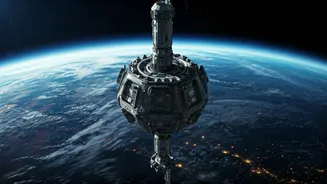
The central feature of the rotating space station is, unsurprisingly, its rotating structure. The design is likely to incorporate a central hub and peripheral modules. The modules would be connected to the central hub, and the entire structure would spin around a central axis. This spinning motion creates centrifugal force, which acts as artificial gravity for the occupants. The speed of rotation would be carefully calibrated to simulate Earth's gravity or a fraction thereof, depending on the mission's requirements. The patent likely addresses the mechanical aspects of this rotation, including bearing systems, propulsion methods for maintaining rotation, and mechanisms for docking with other spacecraft. Furthermore, design elements likely address preventing disruptions to the station's functions due to the forces generated by rotation. The engineering considerations required for such a structure are complex, necessitating precision and robust design.
Benefits for Astronauts
One of the most significant anticipated benefits of the rotating space station is improved astronaut health during extended missions. Prolonged exposure to zero gravity leads to several adverse health effects. The absence of gravitational forces causes bone density loss and muscle weakening. Additionally, it causes fluid shifts within the body, which can strain the cardiovascular system. Artificial gravity, generated by the station's rotation, can counter these effects. This allows astronauts to live and work more comfortably in space. By providing a familiar environment, it reduces the physical strain and psychological challenges associated with extended space travel. The ability to maintain bone and muscle mass is particularly crucial for missions to Mars or beyond, as these voyages can last several years. The design, therefore, represents a move towards making long-duration space travel much more viable and safe.
Challenges and Innovations
While the rotating space station concept holds great promise, it also presents significant engineering and design challenges. Constructing a large-scale structure that can rotate smoothly in the vacuum of space requires extremely precise engineering and advanced materials. Managing the transfer of power, data, and resources between the rotating sections and the stationary core is another major hurdle. This can involve slip rings or wireless communication systems. The design also must address the potential for motion sickness among astronauts as they adjust to the artificial gravity. However, Russia's patent also highlights potential innovations in materials and construction techniques. The development of lightweight yet durable structural components and advanced control systems will be critical to the project's success. The station's design will probably incorporate redundant systems to ensure mission-critical functions even in the event of component failure. Thus, the successful realization of this concept depends on advances in several engineering fields.
Future of Space Travel
Russia's rotating space station concept, if realized, could have a profound effect on the future of space exploration. It would enable longer and more ambitious missions, potentially paving the way for sustained human presence in space. The ability to simulate gravity could greatly increase the comfort and safety of astronauts, reducing many of the health risks associated with long-duration spaceflight. This would also facilitate more complex scientific experiments and research in a near-Earth environment. The project signifies a shift toward exploring new frontiers and achieving interstellar travel. The innovation also underscores Russia's continued commitment to space exploration and its pursuit of leading-edge technologies. The development of such a station may inspire similar concepts from other space agencies and private companies, accelerating advancements in space travel.