


Viral Video Deception
Recent social media buzz centered on claims of a hydrogen-powered train conducting trial runs on the renowned Kalka-Shimla railway line in Himachal Pradesh.
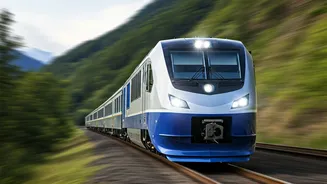
These claims, amplified by content creators, have unfortunately led to widespread public confusion. However, a closer examination reveals that the train featured in the widely circulated video is not a hydrogen-operated Vande Bharat. Instead, it is a Diesel Hydraulic Multiple Unit (DHMU) coach that was being tested on the historic narrow-gauge track. The visual of a new, distinct train arriving at Shimla station, different from the familiar toy train, understandably generated excitement, but the underlying technology driving it is not the advanced hydrogen propulsion that many assumed. This distinction is crucial as the development of true hydrogen-powered trains progresses separately.
DHMU Trials Unveiled
The Diesel Hydraulic Multiple Unit (DHMU) coaches were indeed brought to the 90-kilometer Kalka-Shimla narrow-gauge route, a UNESCO World Heritage site, specifically for testing purposes. The video captured its arrival at Shimla station, suggesting a completed test run. Onlookers were drawn to this unfamiliar sight, documenting its presence on a line typically served by the iconic toy train. These trials involved adding extra weight to the DHMU to evaluate its performance under load. Starting from Kalka at 8:46 am, the train made deliberate, short stops at stations like Dharampur and Solan, allowing officials to meticulously monitor the engine's temperature and overall operation. Further checks were conducted at Kandaghat, Shoghi, and Taradevi. Throughout this phase, the train maintained a steady speed of 28 kilometers per hour. A significant positive outcome of these tests was the engine's consistent cooling and lack of overheating, indicating a robust cooling system that functioned effectively across all coaches. Beyond mechanical checks, basic amenities such as air conditioning, lighting, LED displays, and the power control system were thoroughly assessed to ensure everything was in working order before any potential public deployment.
Hydrogen Vande Bharat Progress
Concurrently, the Integral Coach Factory (ICF) in Chennai is actively engaged in developing a hydrogen-powered Vande Bharat train. This ambitious project, initially slated for a January 2026 commencement of operations, has experienced delays. Once operational, this advanced train is projected to cover a significant 356-kilometer route, with plans for phased expansions. It's designed to facilitate two daily services and accommodate over 2,000 passengers, showcasing a substantial capacity increase. The eco-friendly nature of this train is highlighted by its impressive efficiency: it's engineered to travel two kilometers per kilogram of hydrogen consumed. This indicates a commitment to sustainable and efficient rail travel, aligning with broader environmental goals for the country's transportation sector.
Hydrogen Train's Future Route
The designated operational route for the forthcoming hydrogen Vande Bharat train is planned to be between Sonipat and Jind in Haryana. While official fare structures have not yet been announced, the service is expected to include four to five stops along this route, providing convenient boarding and alighting points for passengers. This strategic choice of route aims to introduce and test the hydrogen technology in a real-world setting, paving the way for its eventual expansion to other corridors. The development and eventual deployment of this train represent a significant step towards decarbonizing the Indian railway network and exploring alternative fuel sources for mass transit.
DHMU Design and Comfort
The Diesel Hydraulic Multiple Unit (DHMU) coaches deployed for testing on the Kalka-Shimla line feature an exterior aesthetic inspired by snow-capped mountains, a fitting design for the scenic route. The coaches are securely integrated, ensuring a cohesive unit. The specific configuration tested included a coach housing the engine with 19 seats, an adjacent coach also with 19 seats, and a central coach offering 21 passenger seats. Inside, the train is equipped with modern lighting systems and advanced safety features, including measures designed to mitigate fire risks. To enhance passenger convenience, mobile charging points have been integrated into the coaches, ensuring travelers can keep their devices powered throughout their journey. These design elements focus on both functionality and passenger comfort, even for a testing unit.