




Ancient Galaxies Revealed
Recent investigations leveraging the unparalleled capabilities of NASA's James Webb Space Telescope (JWST) have yielded astonishing insights into the universe's
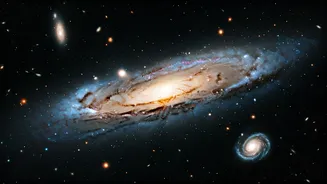
nascent stages. The telescope has captured breathtaking imagery of galaxies that existed just a few hundred million years after the Big Bang. What's truly remarkable is that a new study analyzing these observations suggests these early galaxies are almost as old as the universe was at that specific epoch. Astronomers employed sophisticated evolutionary synthesis models, such as those developed by Bruzual and Charlot, to examine 31 galaxies situated at a redshift of approximately 7.3. Their findings indicate an average stellar age of around 600 million years for these galaxies. This means they were already well-established structures when the cosmos itself was a mere fraction of its current age. This discovery challenges previous assumptions about the rate at which galaxies could form and mature in the infant universe, suggesting a more rapid cosmic evolution than previously theorized.
Anomalies in Cosmic History
Further analysis of JWST data has pinpointed 31 galaxies within the redshift range of z≈6–10, a period when the universe was approximately 500 to 800 million years old. The research meticulously accounted for various factors that could influence age estimates, including the presence of interstellar dust and the activity of supermassive black holes at galactic centers. The resulting average stellar age calculated for these galaxies was around 600 million years, a figure that closely mirrors the age of the universe at that time. The most striking anomaly comes from a specific galaxy, designated JADES-1050323, observed at z=6.9. This particular galaxy appears to be older than the universe itself, a conclusion that, if validated, would necessitate a significant reevaluation of the standard cosmological model. This finding is not entirely isolated; other researchers have also reported 'strong anomalies' in early JWST galaxies, pointing towards unexpectedly mature stellar populations that seem to have formed much earlier than anticipated. These consistent observations of 'unexpectedly old' galaxies suggest a fundamental re-thinking of early cosmic history may be required.
Cosmological Implications Explored
These extraordinary findings from the JWST are contributing to a growing pattern of surprising revelations emerging from the study of the early universe. They join other recent discoveries that question our established timelines and evolutionary processes. For instance, prior surveys had identified galaxies situated 12.5 billion light-years away that were already surprisingly rich in heavy elements like carbon and oxygen. For that particular cosmic epoch, such chemical maturity was deemed unusual. Furthermore, other scientific inquiries have reported the existence of massive and highly evolved galaxies appearing just a few billion years after the Big Bang. When considered collectively, these anomalies strongly suggest that the processes of galaxy formation and evolution unfolded at a considerably faster pace than predicted by current standard cosmological models. If the age estimates derived from Webb's new observations prove to be accurate and hold up under further scrutiny, the widely accepted Lambda-CDM model, which describes the universe's evolution, may require substantial revisions to accommodate these unexpected observations of ancient and rapidly formed galaxies.