
JWST’s Cosmic Vision
The James Webb Space Telescope, or JWST, is a powerful space telescope designed to observe the universe in infrared light. This capability allows it to peer
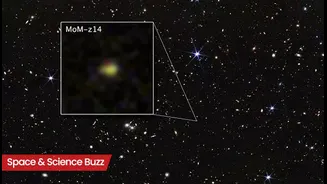
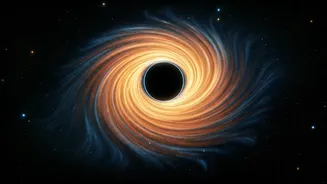
through dust clouds and observe distant galaxies and objects that are otherwise invisible to other telescopes. JWST's mission is to explore the cosmos and analyze the universe, peering back in time to the earliest galaxies and stars. The telescope’s ability to capture faint infrared signals has enabled it to observe the universe's first supermassive black holes. JWST’s data offers unprecedented detail about these objects, including their mass, growth rates, and environment. The telescope's observations are helping astronomers understand the processes that led to the formation of the earliest supermassive black holes, a key step in understanding galaxy formation and evolution. The data from JWST is vital, pushing the boundaries of what astronomers know and can study. Its findings are helping redefine understanding of the cosmos, providing insights into some of the universe's most complex and mysterious objects.
Early Black Hole Formation
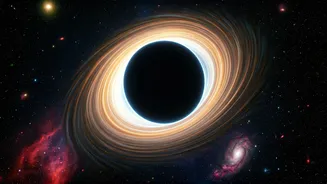
One of the most intriguing questions in astrophysics is how supermassive black holes formed so quickly after the Big Bang. Some of the earliest galaxies contained supermassive black holes within a few hundred million years of the Big Bang. Explaining the rapid growth of these objects poses a challenge, as conventional models suggest a slower growth rate. JWST's observations of these early black holes may help solve this puzzle. The telescope has observed supermassive black holes with masses equivalent to millions or billions of times the mass of the Sun. They are found in galaxies that existed when the universe was less than a billion years old. Various theories are being explored, including direct collapse, where a large cloud of gas directly forms a black hole; and accretion, where a black hole grows by swallowing gas and dust. JWST offers an extraordinary view of these processes, which is helping scientists better understand the conditions that allowed these objects to grow so large so early in the universe. New findings from JWST are expected to refine these theories, adding clarity to how these objects came to exist.
Supermassive Black Hole Details
JWST’s detailed observations enable astronomers to study supermassive black holes in great detail. Analyzing the light from these objects provides insights into their environments. By studying the light emitted by the material around the black holes, astronomers can determine properties like the mass of the black hole, the rate at which it is growing, and the composition of the material it is consuming. JWST’s images also reveal how these black holes influence their surrounding galaxies. The powerful jets of energy and particles launched by the black holes have significant impact. These jets can heat the surrounding gas and halt star formation, affecting the galaxy’s evolution. Data from the JWST is helping astronomers understand the interactions between black holes and the galaxies that host them. Understanding these interactions is essential for a complete model of galaxy formation. The JWST's observations have the potential to revise how we understand the evolution of galaxies.
Implications and Future Research
The discoveries made by JWST regarding supermassive black holes have important implications for cosmology and astrophysics. The fact that the telescope can see so far back in time suggests that some conventional models may need revision. These observations are helping to test and refine models. Further research will focus on studying more black holes at different distances to gather more data. Future investigations include analyzing the formation of galaxies and their correlation with black hole growth. The JWST will be a key resource, capturing data that is essential for understanding the origins and evolution of black holes. These continued studies will provide a more detailed understanding of the role these cosmic objects play. As technology advances, more data will be accessible to further research. This will allow scientists to improve models of the early universe.