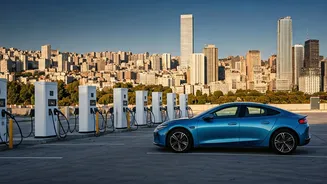








Massive Charger Deficit
India is experiencing a significant surge in electric vehicle (EV) adoption, largely propelled by escalating fuel prices, a growing environmental consciousness,
and supportive government initiatives. While electric two-wheelers and commercial fleets are spearheading this transition, particularly in urban areas, the necessary charging infrastructure is struggling to keep pace. Delhi, a major hub for this shift, currently boasts only 8,998 EV charging points. Astonishingly, this falls drastically short of the estimated requirement of 36,177, creating a staggering deficit of over 27,000 chargers. This profound gap underscores a critical challenge: the rapid growth of EV ownership is outstripping the development of essential charging facilities, even with robust policy frameworks in place.
Ambitious Plans, Lingering Gaps
Despite the substantial shortfall, the Delhi government has outlined plans to bolster its EV charging network, aiming to increase the number of charging points to 16,070 by the close of the current year. However, even achieving this ambitious target, which effectively doubles the current capacity, will still leave the city with a considerable gap of more than 20,000 chargers. This projection raises significant questions about the long-term viability and readiness of Delhi's charging ecosystem to accommodate its growing EV fleet. The situation highlights the immense challenge of building out infrastructure at a speed that matches, or even anticipates, the rapid uptake of electric vehicles.
NCR's Uneven Landscape
The EV charging infrastructure landscape across the wider National Capital Region (NCR) presents a similarly concerning, and in some cases, even more dire picture. Cities like Gurgaon and Faridabad are currently completely devoid of public EV charging points, despite having estimated needs of 20 and 26 chargers respectively. This lack of basic infrastructure in major urban centers points to a significant disparity and unevenness in EV infrastructure planning across the region. Noida, while slightly better off, has only 69 charging points against an anticipated need of 150, and Greater Noida lags even further with just three chargers where 16 are required. Ghaziabad, with 126 chargers, also falls considerably short of its 450-charger requirement. While plans exist to add 100 chargers by year-end, a substantial deficit is projected to persist.
Reliance and Expansion Efforts
Within Delhi's existing 8,998 charging points, a striking majority, 8,849, are managed by the transport department, with only 149 under the purview of the Delhi Metro Rail Corporation (DMRC). This overwhelming reliance on government agencies raises important questions about the extent of private sector involvement and investment in the EV charging ecosystem. In an effort to expand access, plans are underway to install 66 additional charging points at various Delhi Metro stations. Furthermore, six charging points are slated for installation at both the Anand Vihar and New Ashok Nagar RRTS stations, which aims to enhance last-mile charging convenience for commuters.
Battery Swapping and Future Needs
Beyond fixed charging stations, Delhi also offers 948 battery-swapping stations, though this is still below the requirement of 1,606. The city has set a target to increase this number to 1,268 stations by 2026. However, experts emphasize that for the burgeoning segments of two-wheelers and delivery fleets, a more rapid deployment of battery-swapping facilities is crucial to ensure operational efficiency and convenience. The overall growth of EVs hinges on a comprehensive charging ecosystem that integrates various solutions, including rapid-charging hubs, efficient battery swapping, and accessible destination charging points. Simply increasing the number of public chargers without strategic placement based on demand patterns may not yield optimal results. Consequently, there is a strong call for 'Right to Charge' legislation, empowering residents to install chargers in their private parking spaces and mandating that a portion of parking in new constructions be EV-ready from the outset.