
Adult Occupant Protection
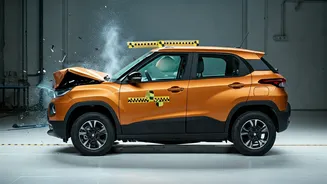
During the Bharat NCAP crash tests, the Tata Punch Facelift exhibited impressive performance in safeguarding adult occupants. The evaluation considered
both frontal and side impact scenarios, with the car's structural integrity and safety features working in concert to minimize potential injuries. The 5-star rating for adult occupant protection reflects the effectiveness of the vehicle's design in absorbing impact forces, keeping the cabin intact, and protecting passengers from serious harm. Engineers paid careful attention to the front and side structures to ensure they could effectively distribute energy during a collision, reducing the risk of injuries to the occupants. The car's robust build, coupled with its safety components, demonstrated a strong ability to protect its passengers in various impact scenarios, solidifying its position as a safety-conscious vehicle.
Child Occupant Protection
Child occupant protection is another crucial aspect of the Tata Punch Facelift's performance, as evaluated by Bharat NCAP. The car's design includes features dedicated to shielding children in the event of a collision, such as ISOFIX anchorages and child restraint systems. These elements were thoroughly assessed to ascertain their efficacy in securing child seats and providing adequate protection during different impact scenarios. The Punch Facelift's performance in this category emphasizes the manufacturer's attention to detail when designing safety measures, specifically for young passengers. The inclusion of features, along with an emphasis on structural integrity, plays a significant role in reducing injuries during collisions. The child safety rating contributes significantly to the overall safety assessment, underscoring the importance of protecting the most vulnerable occupants.
Key Safety Features
Several key safety features contribute to the Tata Punch Facelift's high safety rating. These include airbags, which deploy to cushion occupants during collisions, along with anti-lock braking systems (ABS), which help prevent wheel lock-up during braking, maintaining steering control. Electronic stability control (ESC) is included to assist in maintaining vehicle stability in demanding driving conditions. These technologies work synergistically to reduce the risk of accidents and mitigate the severity of injuries if one occurs. The strategic deployment of these features, alongside the robust structural design, enhances the Punch Facelift's ability to protect occupants in a variety of impact scenarios. These are designed to provide comprehensive protection, ensuring that the vehicle meets and exceeds safety standards.
Price and Rivals
Understanding the Tata Punch Facelift’s price point and its competitive positioning is also relevant. By comparing it to rival vehicles in its segment, consumers can evaluate its overall value proposition, considering safety features, performance, and cost. The Punch Facelift's safety rating could be a key differentiator, influencing purchasing decisions for buyers who prioritize safety. As such, it is important to analyze its pricing and safety features. Comparisons to similar vehicles on the market enable potential buyers to make informed choices. This also gives a good view of the Punch Facelift's place in the market and how its safety credentials stack up.