






Submerged Secrets Unveiled
Beneath the tranquil blue waters of Chuuk Lagoon, located in the Federated States of Micronesia, lies a somber testament to a past conflict. What appears
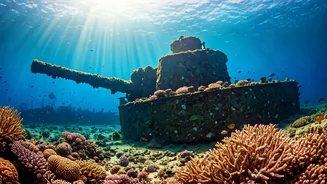
to be an idyllic tropical setting masks a vast underwater museum of World War II history. This remote Pacific atoll, once known as Truk Lagoon, transformed into an eerie graveyard after a pivotal moment in the war. Dozens of Japanese ships and aircraft met their fate here, now resting silently on the seabed. These submerged relics, remarkably preserved by the ocean's embrace, have captivated explorers and historians alike, creating a haunting ambiance that draws visitors from across the globe to witness this frozen moment in time. It's a place where the beauty of marine life now flourishes amidst the remnants of human conflict, offering a poignant juxtaposition of life and history.
Operation Hailstone's Legacy
The profound historical significance of Chuuk Lagoon is indelibly linked to the devastating events of February 1944, during World War II. In a massive offensive known as Operation Hailstone, the United States launched a formidable air and naval assault against Japanese military installations in the region. This intense operation resulted in the catastrophic sinking of a substantial fleet of Japanese vessels, including numerous cargo ships, warships, and aircraft. The sheer scale of the destruction meant that many of these war machines and their payloads were submerged directly within the confines of the lagoon. The debris field created by this attack is so vast that the lagoon became one of the most concentrated collections of sunken wartime materiel in the world, a chilling reminder of the war's reach even into these remote Pacific waters.
Diver's Paradise, Ghostly Tales
Today, Chuuk Lagoon is celebrated globally as an unparalleled destination for wreck diving, attracting a dedicated community of underwater adventurers. Divers flock to experience the extraordinary visibility and the exceptionally well-preserved state of the World War II wrecks. Beyond the thrill of exploration, these submerged artifacts—ranging from massive freighters to fighter planes—remain laden with their original cargo, machinery, and even personal effects. This intactness provides an unparalleled glimpse into the realities of wartime naval operations. However, the profound tragedy and the sheer volume of lost lives and equipment have also imbued Chuuk Lagoon with a reputation as one of the planet's most haunted underwater sites. The silent wrecks, coupled with the lagoon's remote and somewhat isolated nature, contribute to an atmosphere ripe with mystery, spectral legends, and a deep sense of melancholic beauty where history's sorrow meets the vibrant present of the ocean.