


Salar de Uyuni's Mirror
Imagine a world where the sky meets the earth in a seamless reflection. Bolivia's Salar de Uyuni, the world's largest salt flat, transforms into a colossal
natural mirror after rainfall. During the wet season, a thin layer of water blankets the vast expanse, creating an illusion of infinite sky. This surreal panorama is a photographer's dream, offering a truly disorienting yet beautiful experience as you walk amidst the clouds. The sheer scale of this phenomenon, stretching over 10,000 square kilometers, makes it one of the most otherworldly sights on our planet. It's a place where the boundaries between heaven and earth blur into a breathtaking spectacle, inviting visitors to step into a dreamlike reality.
Giant's Causeway's Columns
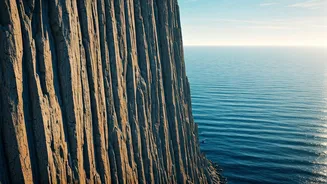
Northern Ireland's Giant's Causeway is a geological marvel composed of approximately 40,000 interlocking basalt columns. Legend has it that the giant Finn McCool built this causeway to walk to Scotland, but science points to ancient volcanic activity. The hexagonal shapes of these pillars, most of which are between 11 and 15 meters high, are a result of cooling lava flows. Walking among these neatly arranged geometric structures feels like stepping into an ancient, natural architecture project. The dramatic coastline setting only adds to the mystique, making it a truly unforgettable natural wonder that sparks imagination and awe in equal measure.
Pamukkale's Terraces
Turkey's Pamukkale, meaning 'Cotton Castle' in Turkish, features dazzling white travertine terraces filled with thermal water. These terraces have been formed over centuries by mineral-rich hot springs cascading down the hillside. The pure white calcium carbonate deposits create a surreal, snow-capped appearance, even in warm weather. The pools within these terraces offer a unique bathing experience, surrounded by this ethereal landscape. It's a place where natural beauty meets therapeutic waters, creating a visual spectacle that resembles frozen waterfalls or a fantastical, mineral-rich landscape that seems too pristine to be natural.
Antelope Canyon's Curves
Arizona's Antelope Canyon is a slot canyon known for its breathtaking sculpted sandstone walls. Sunlight filters down through narrow openings at the top, casting dramatic beams and illuminating the rock in a spectrum of oranges, reds, and purples. The wind and water erosion over millions of years have carved these smooth, flowing curves and waves into the sandstone, creating an organic, almost fluid appearance. Walking through the canyon feels like navigating the interior of a giant, surreal sculpture, with light and shadow playing continuously across the vibrant hues.
Zhangjiajie's Pillars
China's Zhangjiajie National Forest Park is famous for its towering sandstone pillars, some reaching over 200 meters high. These unique geological formations, often shrouded in mist, inspired the floating mountains in the movie 'Avatar'. The extreme erosion, combined with heavy rainfall, has shaped these quartz-sandstone peaks over millions of years. Visitors can explore via pathways, cable cars, and even glass bridges, offering unparalleled views of this surreal, vertical landscape. It's a place that truly embodies a fantasy realm, with its gravity-defying rock formations.
Marble Caves' Swirls
Patagonia's General Carrera Lake in Chile is home to the stunning Marble Caves (Capillas de Mármol). These natural formations are intricate caves and tunnels carved by the turquoise waters of the lake into solid marble cliffs over thousands of years. The swirling patterns of blue, white, and grey on the cave walls, constantly reflecting the vibrant water, create a mesmerizing, almost surreal artistic display. Accessible only by boat, these caves offer an intimate encounter with a geological masterpiece shaped by the relentless artistry of water and stone.
Danakil Depression's Colors
Ethiopia's Danakil Depression is one of the hottest, lowest, and driest places on Earth, yet it's also one of the most visually striking. This volcanic region is characterized by vibrant, otherworldly colors created by mineral deposits from hot springs and volcanic activity. Acid pools, salt formations, and sulfur springs paint the landscape in surreal shades of yellow, green, and red, resembling an alien planet. The extreme conditions and unique geology make it a harsh but incredibly beautiful and bizarre environment.
Plitvice Lakes' Cascades
Croatia's Plitvice Lakes National Park is a breathtaking natural wonderland featuring a series of 16 terraced lakes connected by countless waterfalls and cascades. The water's striking turquoise and emerald hues are due to minerals and organisms. Wooden walkways wind through the park, allowing visitors to immerse themselves in this pristine aquatic landscape. The constant movement of water, the lush greenery, and the vibrant colors create a magical, fairytale-like atmosphere that feels almost too perfect to be real.
Socotra Island's Flora
Off the coast of Yemen lies Socotra Island, a UNESCO World Heritage site renowned for its unique and endemic flora, most notably the Dragon's Blood Tree. These trees, with their umbrella-like canopies and red sap, along with other bizarre plant species, create a landscape that appears to have been transported from another planet. The isolation of the island has fostered an incredible biodiversity, resulting in a truly alien and ancient-looking environment that captivates the imagination with its prehistoric charm.
Yellowstone's Hot Springs
Wyoming's Yellowstone National Park is a geothermal wonderland, famous for its array of vibrant hot springs, geysers, and colorful pools. The Grand Prismatic Spring, the park's largest hot spring, is renowned for its vivid bands of orange, yellow, and green, radiating from a deep blue center. These colors are created by thermophilic bacteria that thrive in different temperature zones. The otherworldly appearance of these thermal features, coupled with the steam rising into the air, gives the landscape a surreal, almost alien, and prehistoric feel.