





Majestic Waterfalls Beckon
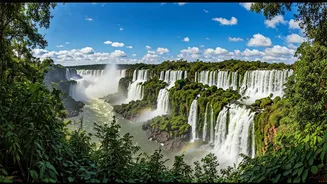
Prepare to be mesmerized by the sheer power and beauty of Iguaçu Falls, a spectacular series of cataracts situated on the Iguaçu River, precisely 14 miles
(23 km) upstream from its junction with the Alto (Upper) Paraná River, straddling the border between Argentina and Brazil. This breathtaking natural wonder forms an expansive horseshoe shape that stretches an impressive 1.7 miles (2.7 km) across, making it nearly three times wider than the renowned Niagara Falls found in North America. The sheer volume of water cascading over the edge creates a symphony of sound and a constant mist, offering an unforgettable visual and auditory experience for all who visit this South American gem.
Sacred Mountain Retreat
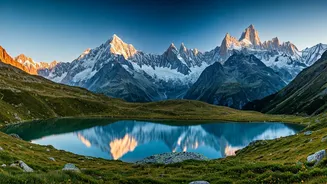
Journey to Mount Athos, a distinctive mountain located in the northern region of Greece, which is home to a unique semiautonomous republic inhabited exclusively by Greek Orthodox monks. This spiritual enclave encompasses 20 distinct monasteries, along with various dependencies known as skítes. Remarkably, some of these monastic settlements are of such scale that they rival the size of their parent monasteries, showcasing a rich history of devotion and architectural endurance. Mount Athos occupies the easternmost of the three prominent peninsulas that form the Chalcidice region, offering a serene and historically significant pilgrimage site.
Buddha's Enlightenment Site
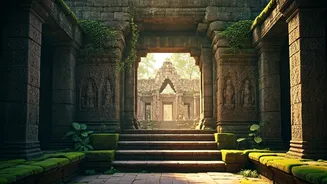
Discover the profound significance of the Mahabodhi Temple, recognized as one of Buddhism's most sacred sites. This hallowed ground marks the very location where the Buddha attained enlightenment, an event known as Bodhi. Nestled in Bodh Gaya, within the central Bihar state of northeastern India, the temple stands serenely on the banks of the Niranjana River. The Mahabodhi Temple is distinguished as one of India's oldest brick temples, with its original construction laying the foundation for centuries of spiritual pilgrimage and devotion. Its historical and religious importance draws seekers from across the globe.
Iconic Waterfall Spectacle
Experience the awe-inspiring spectacle of Niagara Falls, a world-famous waterfall located on the Niagara River in northeastern North America. This iconic natural wonder straddles the international border between Ontario, Canada, and New York state, U.S., captivating millions of visitors annually. For many decades, Niagara Falls has been a beloved destination for honeymooners and adventurers, attracting those who marvel at its power and beauty, and famously, those who dared to undertake daring stunts like walking across it. It remains a quintessential symbol of natural grandeur.
Unique Saltwater Lake
Explore the unique geography of the Dead Sea, a landlocked salt lake nestled between Israel and Jordan in the southwestern region of Asia. Its eastern shoreline is part of Jordan, while the southern portion of its western shore belongs to Israel. The northern segment of the western shore is situated within the Palestinian West Bank, which has been under Israeli occupation since a specific historical period. The exceptionally high salinity of the Dead Sea allows individuals to float effortlessly, making it a distinctive natural phenomenon and tourist attraction.
Nepal's Holiest Shrine
Venture to the Pashupatinath Temple, a significant place of worship situated in the Kathmandu Valley on the banks of the Baghmati River. Located on the eastern outskirts of Kathmandu, the capital city, it holds the esteemed title of Nepal's holiest site. This ancient temple is dedicated to Lord Shiva, revered here in his form as Pashupati, the protector of animals. Historical records indicate that a religious foundation has existed at this sacred location for an extended period, contributing to its profound spiritual importance and cultural heritage.
Aboriginal Sacred Monolith
Discover Uluru, also known as Ayers Rock, a monumental monolith that stands as one of the most significant tors (isolated masses of weathered rock) in the southwestern Northern Territory of central Australia. For countless generations, Uluru has been deeply revered by various Australian Aboriginal peoples of the region, who refer to it by its traditional name, Uluru. The towering sandstone formation was first sighted by European explorer Ernest Giles in 1872, marking a significant moment in the exploration of the Australian Outback and drawing global attention to this sacred site.
Ancient Roman Baths
Step back in time at the Roman Baths, an exceptionally well-preserved public bathing facility that was constructed around 70 CE. Built on the site of natural geothermal springs in Roman Britain, this historical marvel is now located in the city of Bath, England, U.K. The mineral springs here are renowned for their high temperatures, bubbling up from the ground at well over 104 °F (40 °C). The primary spring alone is capable of producing more than 300,000 gallons (1.3 million liters) of hot water daily, a testament to the enduring power of these natural thermal resources.
Massive Buddhist Monument
Marvel at Borobudur, an immense Buddhist monument located in the heart of central Java, Indonesia, approximately 26 miles (42 km) northwest of Yogyakarta. This architectural masterpiece intricately blends the symbolic forms of the stupa, a Buddhist commemorative mound typically housing sacred relics, with the concept of the temple mountain, which is based on Mount Meru from Hindu mythology. Borobudur stands as a profound representation of religious cosmology and artistic achievement, drawing visitors to its monumental scale and intricate design.
Ancient Chimú Capital
Explore the vast ruins of Chan Chan, a historically significant and now abandoned city that once served as the thriving capital of the Chimú kingdom between approximately 1100 and 1470 CE. This sprawling metropolis held the distinction of being the largest city in pre-Columbian America. Chan Chan is situated on the northern coast of present-day Peru, roughly 300 miles (480 km) north of Lima, within the Moche valley. Its strategic location between the vast Pacific Ocean and the fertile lands provided a rich foundation for its once-powerful civilization.
Historic Islamic Shrine
Visit the Dome of the Rock, an iconic shrine located in Jerusalem, commissioned by the Umayyad caliph ʿAbd al-Malik ibn Marwān in the late 7th century CE. It proudly holds the title of the oldest extant Islamic monument in the world. The structure is strategically positioned on a flat, elevated plaza known to Muslims as al-Ḥaram al-Sharīf, meaning 'The Noble Sanctuary,' and is also recognized by Jews as the Temple Mount. Its architectural brilliance and historical context make it a site of immense religious and cultural significance.
Ancient Nabataean City
Uncover the marvels of Petra, an ancient city that flourished as the central hub of an Arab kingdom during the Hellenistic and Roman periods. The remarkable ruins of this once-great metropolis are found in southwestern Jordan. Petra was ingeniously carved into a natural terrace, dramatically bisected from east to west by the Wadi Mūsā, also known as the Valley of Moses. This very valley is traditionally recognized as one of the locations where the Israelite leader Moses struck a rock, causing water to flow.