




The Prelude to Colours
Holi, widely recognized as the festival of colours, commences not with vibrant hues and joyous revelry, but with a significant ritual known as Holika Dahan.
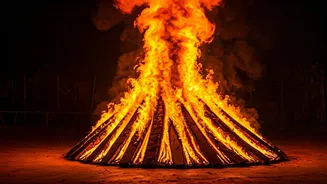
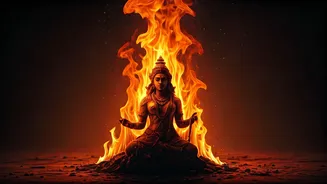
This ceremonial bonfire serves as a powerful symbol for purging negativity and serves as a reminder of an ancient narrative that continues to inspire countless individuals. At the heart of this tradition lies a timeless account of steadfast devotion and divine intervention. The story underscores that the true spirit of Holi is deeply rooted in spiritual significance, with the act of burning Holika representing the eradication of evil and the triumph of good, long before the playful splashing of colours begins.
Bhakt Prahlad's Steadfast Faith
The epic of Bhakt Prahlad forms the cornerstone of Holika Dahan. According to ancient Hindu texts, Prahlad was the son of Hiranyakashipu, a formidable demon king. Despite his lineage, Prahlad developed an unshakeable devotion to Lord Vishnu from a tender age. His father, consumed by immense pride and a thirst for power, demanded to be worshipped as a god. However, Prahlad refused, choosing his faith over his father's oppressive decree. Hiranyakashipu, viewing this defiance as a profound betrayal, made numerous attempts to punish and even end his son's life. Yet, each sinister plot was thwarted, as Prahlad remained protected by divine grace. This narrative powerfully illustrates that genuine belief is impervious to external pressures, regardless of the might of those who oppose it, highlighting the strength found in inner conviction.
Holika's Boon and Downfall
Driven to fury by Prahlad's unwavering devotion to Lord Vishnu, Hiranyakashipu sought the assistance of his sister, Holika. Holika possessed a unique magical boon that rendered her immune to the destructive effects of fire. A wicked scheme was hatched: Holika was to sit in a roaring bonfire with Prahlad nestled in her lap, with the expectation that the flames would consume the boy while she remained unscathed. However, the cosmic order had a different destiny in store. Holika's protective enchantment was conditional; it only offered immunity when she entered the fire alone. By misusing her divine gift for malicious purposes, her protection faltered. Instead of Prahlad, Holika herself was engulfed and consumed by the inferno, while Prahlad, shielded by his faith, emerged entirely unharmed. This pivotal event is commemorated as Holika Dahan, signifying the annihilation of arrogance, cruelty, and all forms of negativity.
Significance of Holika Dahan
Holika Dahan transcends being a mere ritual; it functions as a profound spiritual metaphor. The burning pyre symbolizes the incineration of ego, malevolent intentions, and destructive tendencies. Prahlad, in this narrative, represents unwavering faith, inherent purity, and remarkable resilience in the face of adversity. Conversely, Holika embodies the perils of misusing power and the inevitable consequences of excessive pride and arrogance. The entire event serves as a potent reminder that truth, devotion, and righteousness ultimately prevail over wickedness. On the evening preceding Holi, families convene around the sacred bonfire, offering prayers and engaging in parikrama (circumambulation) as a means of seeking protection from negative influences and embracing a spirit of renewal and hope for the future.
From Fire to Festival
The vibrant explosion of colours that characterizes the day after Holika Dahan is not a random occurrence; it is a joyous expression of victory over darkness. Just as Prahlad's miraculous survival brought forth an era of hope and happiness, the colourful celebrations represent the collective expression of unity, forgiveness, and the embrace of positivity. Therefore, Holi is intrinsically a two-part festival. It begins with Holika Dahan, a crucial step for letting go of all darkness and negativity. This is followed by Rangwali Holi, the day dedicated to embracing life's joys, fostering togetherness, and celebrating the triumph of good. The transition from the solemnity of the bonfire to the exuberance of colours signifies a complete cycle of purification and joyous rebirth, underscoring the festival's deep cultural and spiritual significance for communities.
Timeless Lessons from the Legend
Even in contemporary life, the legend of Prahlad continues to hold profound relevance and resonate deeply within the human spirit. It serves as a powerful reminder of several enduring truths: the importance of standing firm in one's convictions, especially when faced with formidable opposition; the understanding that unchecked power, devoid of humility, inevitably leads to downfall; the affirmation that genuine faith and inherent goodness possess a strength far surpassing the grip of fear; and the recognition that every ending of negativity naturally creates space for new beginnings and opportunities. Holi, therefore, extends beyond mere playful colour skirmishes; it is a profound occasion for inner cleansing, offering forgiveness, and celebrating the ultimate triumph of hope and positivity in our lives.