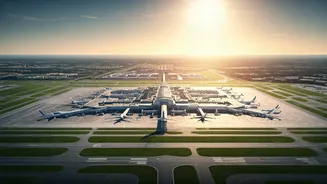

Mumbai's Airport Overview
Chhatrapati Shivaji Maharaj International Airport (BOM) in Mumbai, an essential hub within India, spans approximately 7.5 to 8 square kilometers. The airport's
architecture includes two intersecting runways and a modern integrated Terminal 2. Despite space constraints, it manages over 50 million passengers annually. Its efficiency is recognized globally, operating as one of the busiest single-runway airports. However, its land area contrasts sharply with several international counterparts, revealing the scale of global aviation hubs.
Denver's Expansive Footprint
Denver International Airport in the US presents a stark contrast to Mumbai's airport. Spanning around 53 square miles (137.8 square kilometers), it is the largest airport in North America by land area. This expansive area is roughly double the size of Manhattan. Its footprint exceeds the city limits of Boston, Miami, or San Francisco. The airport is currently undergoing significant upgrades through its Great Hall Program, which is expected to support a future passenger growth forecast to surpass 100 million annually. This expansion reflects the airport's commitment to accommodating increasing air traffic.
Kuala Lumpur's Aviation Hub
Kuala Lumpur International Airport in Malaysia holds its place as the third-largest airport globally. Located in Sepang, Selangor, it covers nearly 100 square kilometers, making it a prominent airport in Southeast Asia. Opened in 1998, KUL serves the greater Kuala Lumpur region and has transformed into a critical hub, particularly for low-cost carriers connecting the region. This strategic positioning has facilitated significant growth in air travel, contributing to its global importance.
Cairo and Its Terminals
Cairo International Airport, the primary aviation hub for Egypt, is the busiest airport in Africa. Situated to the northeast of central Cairo in the Heliopolis area, it covers around 37 square kilometers. The airport's operations are managed through four terminals, seamlessly linked by an automated transport system. The sheer land area of Cairo International Airport considerably surpasses the size of Mumbai's airport, illustrating a notable difference in scale. Its infrastructure supports significant passenger and cargo traffic.
European Airport Giants
Paris Charles de Gaulle Airport, or Roissy Airport, is a significant international gateway for France, and one of Europe’s busiest. Located approximately 23 kilometers northeast of Paris, it features three major terminal complexes. The airport occupies roughly 32.38 square kilometers, a substantial size compared to many European airports. In Spain, Adolfo Suárez Madrid-Barajas Airport, the country's main gateway, covers about 30.5 square kilometers. These European hubs showcase large-scale infrastructure necessary to handle immense air traffic volumes.
Shanghai's International Gateway
Shanghai Pudong International Airport serves as China's primary international gateway and a major global hub. Situated about 30 kilometers east of central Shanghai, it spans roughly 40 square kilometers. The airport plays a crucial role in both passenger and cargo movement. It recently ranked as the second-busiest cargo airport globally. Pudong Airport's 'H'-shaped design, with its two main terminals, reflects its sophisticated operational strategy and capacity to handle massive volumes of air traffic.
Bangkok’s Suvarnabhumi Airport
Suvarnabhumi Airport near Bangkok, Thailand, significantly exceeds Mumbai's size. Constructed approximately 30 kilometers east of the city, it occupies roughly 32.4 square kilometers. Built on land previously known as the “Cobra Swamp,” it is Thailand’s primary international gateway and a major Southeast Asian hub. As of early 2026, it serves more than 113 airlines. Passenger traffic is projected to approach nearly 67.7 million for the fiscal year, highlighting its importance in regional air travel.
Istanbul's New Aviation Hub
Turkey's Istanbul Airport is among the world's most prominent new aviation hubs, situated in the Arnavutköy district. The airport covers around 76.5 square kilometers and houses the world's largest terminal building under a single roof. Istanbul Airport aims to accommodate about 90 million passengers in 2026. This extensive infrastructure makes it the fourth-largest airport worldwide by land area. Its growth reflects Turkey’s ambition to become a major player in international aviation.
King Fahd's Vast Territory
King Fahd International Airport in Dammam, Saudi Arabia, leads the list in terms of land area. Covering nearly 776 to 780 square kilometers, it is the largest airport globally by land area. This scale exceeds the size of the entire country of Bahrain and is comparable to New York City. The airport features a six-story main passenger terminal, along with a Royal Terminal and a dedicated terminal for Saudi Aramco. Its massive size underscores its central role in Saudi Arabia's aviation infrastructure and economic activity.
Dallas/Fort Worth's City
In the US, Dallas/Fort Worth International Airport (DFW) exemplifies large-scale infrastructure, covering over 17,000 acres (69.63 square kilometers). It functions almost like a self-contained city, boasting its own post office, police, and fire departments. DFW is the main hub for American Airlines, which accounts for most of its operations. The airport ranks as the second-largest in the US by land area, after Denver, and is among the world's busiest airports regarding passenger traffic. Its extensive infrastructure supports its role as a major aviation hub.