






Antarctica's Icy Monarch
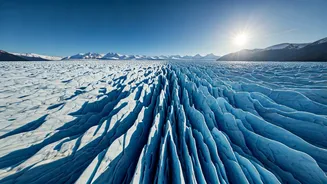
Dominating the frozen continent, the Lambert Glacier in East Antarctica reigns supreme as the world's largest. This colossal ice stream stretches an astounding
400 kilometers (250 miles) in length and is responsible for channeling approximately 8% of the Antarctic ice sheet towards the Amery Ice Shelf. In certain areas, its immense width exceeds 100 kilometers, making it unparalleled in both sheer volume and extent. Its scale is so immense that it significantly influences the dynamics of the surrounding ice, making it a critical component of the Antarctic ecosystem and a key indicator of climate change impacts.
Western Peninsula's Giant
Shifting focus to the western Antarctic Peninsula, we encounter the Seller Glacier, another titan of ice. This vast glacier covers an impressive area exceeding 7,000 square kilometers, distinguishing itself as one of the largest individual glaciers globally. It is notably recognized for its propensity to calve massive tabular icebergs into the surrounding ocean. In recent decades, the Seller Glacier has undergone rapid retreat, a phenomenon closely linked to the prior collapse of the Wordie Ice Shelf, underscoring the vulnerability of these glacial formations to environmental shifts.
Peninsula's Warming Ice
The Antarctic Peninsula Ice Sheet (APIS) represents a vast glacial system, spanning approximately 522,000 square kilometers. Its relatively northern position on the continent makes it particularly susceptible to the accelerated warming observed in this region. This extensive ice sheet covers nearly 80% of the Antarctic Peninsula and maintains an average thickness of about 500 meters. Currently, a significant portion of the APIS, roughly 87% of its constituent glaciers, is actively retreating, signaling a profound impact of climate change on this crucial freshwater reservoir.
Alaska's Piedmont Wonder
Venturing to Alaska, the Malaspina Glacier stands out as the world's largest piedmont glacier, a vast expanse of ice covering approximately 3,900–4,350 square kilometers within Wrangell-St. Elias National Park in southeastern Alaska. The nearby Seward Glacier acts as the primary source of ice flow, guiding glacial movement from the high mountains down to the broader, fan-shaped Malaspina lobe. Curiously, this immense ice formation hosts large areas of glacial forest, though it is experiencing a loss of these unique features, adding another layer of complexity to its ecological significance.
Thurston Island's Ice
Off the coast of mainland Antarctica lies Thurston Island, home to Glacier No. 1, a significant glacial feature spanning an area of approximately 5,261 square kilometers. This glacier, like many of its Antarctic counterparts, remains encased in snow and ice year-round, a testament to its frigid environment. Its substantial size makes it a prominent and noteworthy glacier among the various islands in this remote polar region, contributing significantly to the island's icy landscape.
Alexander Island's Expanse
Alexander Island, the largest island within the Antarctic archipelago, hosts another considerable glacial entity, Glacier No. 1, which extends across approximately 4,766 square kilometers. This region is characterized by extensive and deep ice sheets, coupled with extreme remoteness. This glacier is recognized as one of the two major glacial formations situated on the island, playing a vital role in defining its icy geography and contributing to the overall ice mass of the Antarctic region.
Arctic Canada's Contributor
Moving north to the Canadian Arctic, Wykeham Glacier South commands attention with its impressive size, covering an area of approximately 3,176 square kilometers. Situated in an exceptionally cold and remote environment, this glacier is a crucial contributor of meltwater to nearby rivers and lakes, thereby playing an integral part in the region's hydrological cycle. Its vastness also positions it as one of the most significant glaciers found outside the Antarctic continent, highlighting its global importance.