






Einstein's Prediction Verified
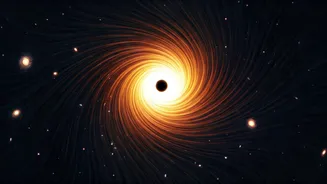
Decades after Albert Einstein proposed the concept of frame-dragging, the effect has been validated through observations of a star's movement around a black
hole. This phenomenon, which Einstein's theory of general relativity predicted, describes how the rotation of a massive object can distort the space-time fabric around it, causing nearby objects to be influenced. The recent observations provided the precise measurements needed to confirm this. The star's wobble, influenced by the black hole's immense gravity and rotation, became the key piece of evidence. This confirms the accuracy of Einstein's century-old theories.
Supernova Unveiled
The James Webb Space Telescope (JWST) has played a pivotal role in revealing the oldest supernova ever observed. This discovery has significant implications for understanding the evolution of the universe. The JWST's capacity to detect distant and faint light sources allowed scientists to pinpoint and analyze the light from the supernova, associated with the gamma-ray burst GRB 250314A. The data provides valuable insights into the early stages of cosmic events and star formation. This remarkable find further enhances the JWST's growing collection of discoveries, solidifying its place as a groundbreaking instrument in astronomy.
Galaxy Cluster Insights
Chandra X-ray observations have yielded stunning, color-coded images that expose the complex structures and activities occurring within galaxy clusters. These massive structures, comprising galaxies, gas, and dark matter, are revealed in unprecedented detail through these X-ray mappings. The colors represent different energy levels, allowing researchers to study the movement of hot gases, the formation of shock waves, and the interactions between galaxies within the clusters. This visualization offers researchers a chance to observe the influence of supermassive black holes located at the centers of these galaxies. The images provide critical data and foster the creation of increasingly sophisticated models of how galaxies evolve in these environments.
Black Holes Activated
A recently discovered connection between galaxy mergers and the activation of supermassive black holes at the galaxies' centers adds to our understanding of galaxy dynamics. As galaxies collide and merge, the forces involved stir up gas and dust around the central black holes. The resulting influx of material causes the black holes to become highly active, emitting powerful jets of radiation and influencing their surroundings. Analyzing the patterns in galaxy mergers helps predict when and where black holes could be activated, helping in the development of models to interpret how these systems work. It has also enabled the study of the growth of black holes and their impact on galaxy evolution, allowing astronomers to explore these phenomena within the structure of the cosmos.