







New Link's Impact
The recently unveiled connecting route on the Mumbai-Pune Expressway, commonly referred to as the 'missing link,' has brought about a remarkable transformation
for the Borghat section. Over the past ten days, approximately 70% of light motor vehicles have opted for this new pathway, significantly alleviating the strain on the older ghat road. This diversion has resulted in a substantial decrease in traffic volume on the original route, with authorities noting that only about 30% of heavy motor vehicles continue to utilize it. The strategic separation of vehicle types has led to a notable improvement in both road safety and the overall fluidity of traffic across both segments of the expressway. Consequently, the reduced congestion has fostered safer travel conditions, with no major accidents or incidents reported on either the new link or the Borghat section during this period, a stark contrast to its historically accident-prone reputation.
Engineering Marvel
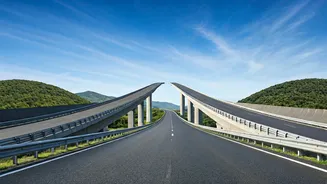
This impressive 19.84-kilometer stretch, which officially opened on May 1st, connects Khopoli in Raigad district directly with Kusgaon near Pune. The ambitious project, costing approximately Rs 6,700 crore, has not only enhanced connectivity but also shortened the distance between Mumbai and Pune by about 6 kilometers, translating to a journey time saving of roughly 30 minutes. The design philosophy behind the new link emphasizes minimal gradients and smoother elevations, enabling vehicles to maintain higher, more consistent speeds compared to the challenging terrain of the older ghat section. A significant component of this new route is an eight-lane carriageway stretching 5.86 kilometers, effectively replacing the former six-lane bottleneck that previously hampered traffic flow. The older Pune-bound Borghat carriageway was notorious for its slow-moving traffic due to speed restrictions imposed by steep inclines, while the Mumbai-bound slope had unfortunately been the site of numerous accidents caused by drivers losing control.
Traffic Reimagined
The introduction of the 'missing link' serves as a definitive long-term solution to the persistent congestion and safety issues that have plagued both sides of the Borghat ghat section, particularly for heavy vehicles. This monumental infrastructure initiative was spearheaded by the Maharashtra State Road Development Corporation (MSRDC), with construction commencing in 2019 and concluding nearly seven years later. Prior to the 'missing link' becoming operational, the Mumbai-Pune Expressway frequently experienced severe traffic snarls at popular tourist and transit points like Lonavala and Khandala. The new alignment adeptly bypasses these critical choke points, leading to a marked improvement in travel efficiency for all motorists. As confirmed by highway safety officials, approximately 70% of vehicles have successfully shifted from the older Borghat route to the new corridor, with the majority of remaining traffic on the old stretch comprising heavy vehicles. This diversion significantly curtails the likelihood of traffic jams on the expressway.
Enhanced Travel Experience
Motorists, especially those driving private cars and other light motor vehicles, are experiencing a markedly smoother journey on the new link due to its flatter surface. This design significantly reduces the risk of engine overheating, a common concern during uphill climbs on the previous route. Concurrently, the older stretch now offers more road space for heavy vehicles, promoting better traffic flow and easing the operational burden on highway patrol teams. Previously, these teams were frequently occupied with rescue operations and responding to accidents, a task that has been considerably reduced with the improved traffic management. The overall impact is a safer, faster, and more predictable travel experience for everyone navigating the crucial Mumbai-Pune corridor.