



RRTS Revolutionizes Delhi Commute
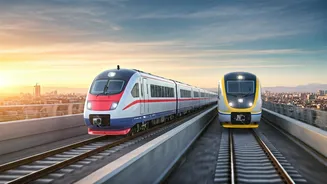
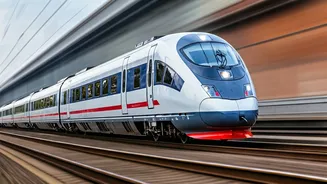
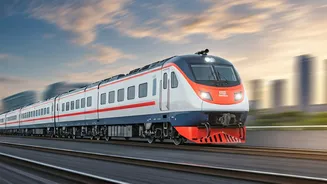
A significant advancement in public transportation has arrived with the full operationalization of the Delhi-Meerut Regional Rapid Transit System (RRTS),
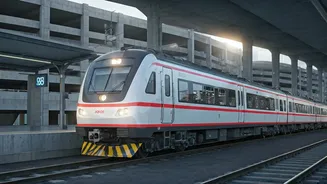
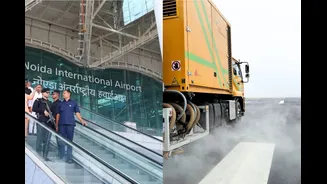
now branded as Namo Bharat. Prime Minister Narendra Modi's recent inauguration of the remaining sections, including the crucial stretch between Sarai Kale Khan and New Ashok Nagar in Delhi, and the 21 km segment from Meerut South to Modipuram in Uttar Pradesh, marks a new chapter for regional connectivity. This state-of-the-art corridor, which also integrates with Meerut Metro services, promises an astonishingly short travel time of just 58 minutes from Sarai Kale Khan to Modipuram. Breaking down the journey, reaching Begumpul will take approximately 54 minutes, while Shatabdi Nagar is accessible in about 50 minutes – all comfortably under an hour. This stands in stark contrast to the conventional road journey, which can easily extend to 90 minutes or more, heavily influenced by traffic congestion. The RRTS represents a monumental leap in improving inter-city travel efficiency and reducing the daily burden on commuters.
Mumbai's Swift Past Surfaces
The launch of the Delhi-Meerut RRTS unexpectedly ignited a wave of nostalgia and debate on social media platform X, centered around Mumbai's public transport capabilities from years past. A user named Rahul Srinivas drew attention by recalling his own daily commute over a decade ago, specifically in 2013. He highlighted his journey from Andheri to Palghar, a distance of approximately 70 km, which he consistently covered in exactly 60 minutes. This claim directly challenged the perceived novelty of the RRTS's speed, prompting a lively discussion about urban mobility across different cities and eras. Srinivas then introduced the "legend: the queen of WR: the 12921/2 Flying Ranee Express" as the vehicle for this swift commute, providing a timetable that illustrated its impressive punctuality and speed. His post shared that the train departed Andheri at 18:10, reached Borivali at 18:22, and arrived in Palghar by 19:10, enabling him to reach home before many of his colleagues commuting to closer suburbs like Thane or Mulund even reached their destinations. He also added a personal note, mentioning that he was often allowed to leave work ten minutes early due to his extended commute from what he described as a 'village,' further emphasizing the significance of this train in his daily life.
Debate on Transport Comparisons
The online conversation sparked by Rahul Srinivas's recollection quickly gained momentum, eliciting a spectrum of reactions. Many users questioned the validity of directly comparing the new RRTS with the Flying Ranee Express, pointing out fundamental differences in their operational contexts. One notable comment suggested that the Delhi-Meerut route would likely see far more frequent usage compared to the Flying Ranee's specific stops. Another user highlighted that Palghar was fortunate to even be a stop for the Flying Ranee, with some commuters from even further stations like Boisar only witnessing the train pass by daily. There was also a query about the Flying Ranee's train type, specifically asking if it was still a double-decker. The core of the disagreement revolved around the number of stops; users argued that the 80 km stretch of the RRTS includes numerous intermediate stations, whereas the Flying Ranee, particularly for the Andheri-Palghar segment, had a considerably more limited number of halts. This led to a nuanced discussion where the direct comparison of speeds was deemed simplistic without accounting for operational scale and infrastructure differences.
Clarifying Intentions
As the digital discussion evolved, Rahul Srinivas stepped in to clarify his original post's intent, addressing the nuances that had arisen. He emphasized that his intention was not to glorify Mumbai's public transport infrastructure, which he acknowledged had its shortcomings, but rather to serve as an indictment of its limitations. For him and many others who relied on the Flying Ranee, it represented a vital escape route, a means to reach home safely and efficiently, avoiding the often-overcrowded and uncomfortable local trains. He expressed gratitude for the train's existence and its role in their daily lives, making it clear that his reference was not an attempt to equate the Flying Ranee with the advanced technological capabilities of the modern RRTS. This clarification reframed the conversation, shifting it from a simple speed comparison to a broader examination of urban mobility, the evolution of public transport infrastructure, and how different cities measure progress and provide essential services to their residents over time.