






Exterior Design & Engineering
The latest iteration of the Duster makes a striking visual statement, blending its signature ruggedness with contemporary design elements tailored for
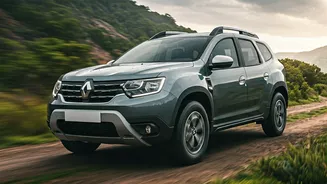
the Indian market. It sports distinctive LED headlights with eyebrow-shaped DRLs and a unique grille that proudly displays 'Duster' instead of the traditional logo, emphasizing its strong brand recall. The front bumper features a nostalgic silver skid plate and functional air curtains, while the overall sculpted bonnet adds to its imposing presence. The India-spec model, built on the robust Renault Global Modular Platform (RGMP), incorporates India-specific touches like Himalayan motifs on the fenders and an 'Iconic' accent strip on the body cladding. Its profile is defined by pronounced black cladding around the wheel arches and functional roof rails with a 50kg load capacity. The vehicle rides on stylish 18-inch alloy wheels and offers a generous 212mm of ground clearance. At the rear, the design is straightforward yet elegant, with triangular LED taillamps connected by a light bar – a feature exclusive to the Indian version. A roof-mounted spoiler enhances its sporty appeal, complemented by a textured license plate housing and a black rear bumper with a silver insert for a rugged finish. The overall dimensions place it firmly within the mid-size SUV segment, measuring 4343mm in length, 1813mm in width, and 1659mm in height, with a substantial 2567mm wheelbase. Notably, the Indian model is 50mm taller than its global counterpart, primarily to accommodate the panoramic sunroof mechanism, which also contributes to a 40mm taller cabin and increased ground clearance. The electrically operated tailgate reveals a class-leading 518 litres of boot space (700 litres up to the roof), though it's a slight drawback that a spare tyre isn't standard, with a puncture repair kit provided instead. The Duster retains its go-anywhere spirit, evidenced by impressive approach and departure angles of 26.9 and 34.7 degrees, respectively, making it well-equipped for challenging terrains.
Interior Space & Comfort
The cabin of the new Duster has undergone a significant transformation, carefully redesigned to cater to local preferences while enhancing the overall user experience. The dashboard is a unique creation, featuring a distinctive dual-screen layout and a thoughtful mix of textured and soft-touch materials, contributing to a more premium ambiance. Accents of silver, faux carbon fibre trim, and contrasting green stitching inject a sense of flair into the functional design. Renault has successfully struck a balance between modern digital interfaces and intuitive physical controls; essential functions like HVAC are managed by a bank of physical buttons on the center console. A unique detail is the differentiation between automatic and manual transmission consoles: the automatic features a high-set, enclosed panel with a deep, cooled storage area, a stubby gear selector, electronic parking brake, and wireless charger. Conversely, the manual version sports a lower-set console with a manual handbrake and an additional shelf for devices. The manual gear lever itself is aesthetically pleasing and comfortable to hold. Practicality is emphasized with a slide-adjustable front armrest containing a storage compartment, a generously sized glovebox, and door bins capable of holding 1-litre bottles. The steering wheel, with its flat bottom and top, is ergonomically designed and houses controls for the instrument cluster and cruise control, while audio controls are located on a separate stalk behind the wheel, reminiscent of the older model. The digital instrument cluster is high-resolution, vibrant, and configurable, although some traditional Duster enthusiasts might prefer the simplicity of classic round dials. The remote key fob, a plastic card-like design similar to the Triber and Kiger, might feel less premium compared to its surroundings. The seats, upholstered in a dual-tone black and dark green fabric with neon green contrast stitching, are visually appealing. Both front seats offer excellent support and padding for long journeys, featuring electric adjustment and a highly effective seat ventilation system. The rear bench comfortably accommodates two adults, with sufficient kneeroom and headroom for individuals up to six feet tall, aided by the large sunroof and windows that enhance the sense of spaciousness. For rear passengers, there's a centre armrest with cupholders, dedicated AC vents, and charging ports, though rear window sunblinds are notably absent. A higher window line compared to the previous generation, which offered superior outward visibility, is a minor trade-off for the updated design.
Features & Safety
The new Duster is thoroughly equipped with the features expected in its segment, aiming to impress tech-savvy buyers. Its infotainment system boasts wireless smartphone integration and, like the digital cluster, displays bright colours and high-resolution graphics on its 10.1-inch touchscreen. A standout feature is the deep integration of Google services, including Google Maps, Google Assistant, and the Google PlayStore, all accessible directly from the system and functioning seamlessly. While the interface is slick and responsive, its navigation can feel less intuitive compared to rivals from Hyundai and Kia, lacking the clarity and logical flow in its menu structure. Beyond the ventilated and powered front seats, other noteworthy features include a panoramic sunroof, wireless phone charging, a 360-degree parking camera (though its resolution could be sharper), a powered tailgate, automatic headlamps and wipers, dual-zone climate control, and connected car technology. The safety suite is comprehensive, featuring six airbags as standard, front and rear parking sensors, a tyre-pressure monitoring system (TPMS), an electronic parking brake (on DCT variants), three-point seatbelts, adjustable headrests, and disc brakes on all four wheels. Significantly, it introduces a Level 2 ADAS (Advanced Driver-Assistance Systems) suite, marking a first for Renault in India. During testing, the ADAS features proved well-calibrated and non-intrusive, with a convenient button on the driver's side allowing for quick deactivation of all ADAS functions without navigating through menus. Renault is also targeting a full 5-star crash safety rating for the new Duster. While the feature set is strong, there's room for improvement in variant-specific feature distribution, with mid-level trims potentially benefiting from features like ventilated seats and leatherette upholstery.
Performance & Refinement
Renault offers the Duster with two turbo-petrol engine options. The entry-level variant features a 1.0-litre, three-cylinder turbo-petrol engine producing 100hp and 160Nm, exclusively paired with a 6-speed manual gearbox. The more powerful option, and the most popular choice accounting for 91 percent of bookings, is the 1.3-litre, four-cylinder turbo-petrol. This engine delivers a segment-leading 163hp and 280Nm, available with either a 6-speed manual or a 6-speed DCT (Dual Clutch Transmission). A strong hybrid option, combining a 1.8-litre petrol engine with an electric motor, is slated for a later introduction. The 1.3-litre turbo-petrol engine is a standout for its refinement, exhibiting virtually no vibrations at idle and maintaining smoothness throughout its rev range. Cabin insulation is excellent, effectively muffling engine noise, which only becomes noticeable at higher RPMs. While there's a slight turbo lag, power delivery is strong around 2500rpm, providing a robust mid-range punch and pulling cleanly to the redline. The DCT transmission, while not as rapid as some competitors' twin-clutch units, offers a smooth, almost torque-converter-like experience, particularly beneficial in low-speed city driving. Paddle shifters are included for enhanced driver engagement during spirited driving. Preliminary acceleration tests indicate a 0-100kph time of approximately 10.4 seconds, which is competitive within the segment. The manual transmission version, favoured by driving enthusiasts, offers excellent control and engagement, especially on winding roads. The clutch is light with a consistent bite point, and the gearbox gates are well-defined for precise shifts. However, the manual encounters more pronounced turbo lag when ascending gradients and requires frequent gear downshifts due to its tall gearing to maintain momentum. The manual variant recorded a slightly slower 0-100kph time of 10.8 seconds. Both variants offer Comfort and Eco drive modes, though the absence of a Sport mode is a minor oversight. The absence of a diesel engine or an AWD option marks a departure from the original Duster's offerings.
Ride Comfort & Handling
The new Duster impressively retains the exceptional ride comfort that was a hallmark of its predecessor, making it a true contender for diverse Indian road conditions. During testing on a route encompassing smooth highways, challenging ghat roads, and rough patches with large rocks, the Duster tackled every obstacle with ease. It exhibits a characteristic European-like firmness, particularly at lower speeds, yet this doesn't translate to discomfort. Instead, it adeptly absorbs imperfections and large potholes, ensuring they don't intrude into the cabin. Unlike the older model, steering kickback is virtually eliminated. The generous sidewall height of the 225/55 R18 tyres contributes significantly to this absorbent ride quality. At highway speeds, the vehicle maintains a stable and composed demeanor. While it’s a front-wheel-drive vehicle, it hasn’t entirely abandoned its go-anywhere ethos. In terms of handling, the Duster offers an enjoyable driving experience around corners. Body control is commendable, although some body roll is present when pushed aggressively, making it feel slightly less planted than rivals like the Skoda Kushaq or Volkswagen Taigun. The steering, though on the lighter side, is precise and provides good feedback on twisty roads. Selectable steering modes, including a configurable 'Individual' setting, allow for adjustable heft, enhancing the experience during spirited driving.
Value & Pricing
Renault presents the Duster across five distinct trim levels: Authentic, Evolution, Techno, Techno+, and Iconic, with prices ranging from Rs 10.29 lakh to Rs 18.49 lakh (ex-showroom). This pricing strategy positions the Duster competitively within the mid-size SUV segment, offering a compelling alternative to rivals. While some competitors like the Citroen Aircross and MG Astor are more affordable at the entry-level, and models such as the Hyundai Creta, Kia Seltos, Tata Sierra, and Maruti Grand Vitara are priced higher at the top end, the Duster strikes a strong balance. Renault is further sweetening the deal with an 'R Pass' pre-booking benefit, which reduces the effective price by Rs 20,000-40,000 and offers priority delivery, among other advantages. A novel subscription program is also being introduced, eliminating the need for a down payment and consolidating on-road costs and servicing into a single monthly fee. Customers can choose from various tenure and mileage options, with flexibility at the end of the term to extend, return, or purchase the vehicle. Adding significant value, the Duster comes with an impressive warranty of up to 7 years or 1,50,000 km, underscoring Renault's confidence in the vehicle's durability. Despite the long wait, the Duster arrives as a well-prepared contender, equipped with rugged styling, a modern interior, desirable features, and an engaging driving experience powered by the 1.3-litre turbo-petrol engine. Its robust build quality suggests it can withstand real-world challenges. While the absence of diesel and AWD options and slightly more rear-seat space might be points of contention for loyalists, the new Duster successfully builds upon its predecessor's strengths while introducing modern refinements that make it a fresh, relevant, and highly desirable SUV.