





AI's Transformative Role
Artificial intelligence is poised to revolutionize the automotive sector, as revealed at CES 2026. This transformation is not merely incremental; it signifies
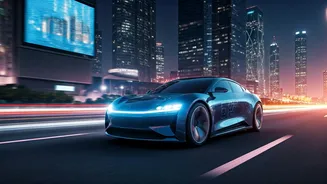
a fundamental shift in how vehicles operate and interact with their users. The integration of AI aims to provide enhanced safety, improve driver assistance systems, and offer personalized in-car experiences. Innovations like Nvidia's Alpamayo are central to this evolution, enabling cars to understand and react to their environment with greater precision. This technological leap allows for more efficient and intuitive driving, reshaping the very essence of automotive technology. The push towards smarter cars promises not only to augment the driving experience but also to redefine how people commute and travel.
Nvidia Alpamayo’s Impact
Nvidia's Alpamayo, a key advancement in AI, brings 'reasoning AI' to self-driving cars, enabling a superior level of cognitive capability. This technology is critical in helping vehicles make decisions in real time, mirroring human-like thought processes. By improving the ability of cars to perceive and interpret surroundings, Alpamayo significantly enhances the reliability and performance of autonomous driving systems. This translates to safer and more efficient navigation, particularly in complex traffic situations. The technology’s deployment signals a shift towards AI that not only processes data but also understands and reacts to it, thereby allowing cars to think and reason like human drivers. This level of sophistication is set to become an essential feature of upcoming models, marking a new chapter in the advancement of automotive technology.
Smarter Cars as Companions
The advancements in AI are creating a paradigm shift, where cars are no longer mere machines, but intelligent companions. This transformation is designed to change the user experience, providing a tailored and interactive environment. These advanced vehicles are equipped to provide entertainment, manage schedules, and even offer support, thus forming a more intricate partnership between the driver and the car. This level of interaction is projected to enhance convenience and safety, making vehicles an integral part of users' daily routines. As cars become more integrated into our lives, they will likely adapt to suit individual preferences, developing a more intuitive interface. The goal is to move beyond mere transportation and provide a comprehensive, personalized driving experience.
Key Technological Advancements
At CES 2026, many technological advances were presented as central to the evolution of smart cars. The developments include sophisticated sensors, improved processing power, and sophisticated software that enable complex operations like object detection, path planning, and driver monitoring. The integration of AI algorithms plays a crucial role in enabling vehicles to analyze vast data sets and adapt to a variety of driving conditions, which results in more efficient and secure driving. Improvements in connectivity, particularly with the introduction of 5G networks, will allow for enhanced communication between vehicles and infrastructure. These advancements work together to create a future where cars are significantly smarter, safer, and more adaptive to the needs of drivers.
Implications for Consumers
The implications of this smart car transformation for consumers are vast. The expected improvements include elevated levels of safety, with AI-driven systems capable of averting accidents. Enhanced convenience features, such as automated parking and personalized settings, are also anticipated. Furthermore, these technological improvements are set to provide a better user experience that is adapted to user preferences. The increased connectivity and interactive capabilities are expected to transform the in-car experience into a more efficient, engaging, and enjoyable one. Ultimately, consumers can look forward to smarter cars which provide an improved driving experience, enhanced safety, and greater personalization.