







The Unexpected Uphill Battle
A recent viral video captured a fascinating automotive showdown on a slippery, muddy incline in Manjhawli. In this remarkable footage, several well-known
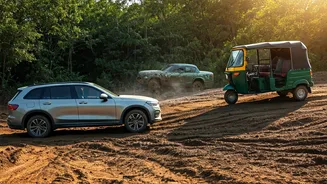
and powerful SUVs, including the Mahindra Scorpio-N, Tata Safari, and Toyota Fortuner, were observed struggling to make progress up the treacherous slope. Their wheels spun fruitlessly, demonstrating a distinct lack of grip. In stark contrast, a Maruti Suzuki Ertiga, a vehicle typically associated with comfort and family commutes, along with an e-rickshaw, traversed the same challenging terrain with surprising ease and smoothness. This visual disparity immediately sparked widespread discussion among car enthusiasts and the general public, raising questions about the actual performance capabilities of these highly-rated SUVs when faced with less-than-ideal driving conditions. The common perception of SUVs as all-conquering vehicles, capable of handling any obstacle, was clearly challenged by this unexpected display, prompting a deeper look into what truly allows a vehicle to conquer such difficult ascents.
Weight vs. Traction Unpacked
The core reason behind the SUVs' struggles on the muddy incline lies in the complex interplay of weight, tire grip, and momentum. While SUVs are often lauded for their higher ground clearance and perceived off-road prowess, their substantial weight can become a significant disadvantage on slick surfaces like mud. The heavier vehicles, including the Mahindra Scorpio-N, Tata Safari, and Toyota Fortuner, sink deeper into the soft earth, making it exponentially harder for their tires to find purchase. In contrast, the lighter Maruti Suzuki Ertiga and the e-rickshaw required less force to initiate and maintain upward movement. A vehicle's power-to-weight ratio becomes critical in such scenarios; a lighter car needs less energy to overcome gravity and the resistance of the terrain. The added mass of the SUVs, rather than aiding them, exacerbated their wheelspin and inability to gain traction, highlighting that brute force is not always the solution when battling slippery inclines.
Tire Tread and Driver Finesse
Beyond weight, the type of tires fitted to a vehicle and the driver's technique play crucial roles in navigating muddy terrains. The SUVs in question were likely equipped with highway-biased tires, designed primarily for on-road comfort and fuel efficiency. These tire patterns offer limited void space for mud to escape, reducing their ability to bite into softer surfaces. Conversely, all-terrain or off-road tires, often found on dedicated off-roaders, possess deeper treads and larger gaps that facilitate better grip and self-cleaning in muddy conditions. Furthermore, driver input is paramount. Abrupt acceleration, as observed with the Scorpio-N and Fortuner in the video, leads to immediate wheelspin, digging the vehicle deeper into the mire. Maintaining a steady, controlled throttle and building momentum gradually, as a skilled driver would, allows the vehicle to maintain forward motion without overpowering the available traction. The ability to keep the wheels turning at a consistent speed without stalling is often the key to successfully ascending a challenging incline.
Mastering the Muddy Ascent
Successfully navigating muddy inclines requires a nuanced approach that prioritizes traction and controlled power delivery over sheer engine output. Drivers encountering such conditions should aim to avoid aggressive acceleration, which inevitably results in wheelspin and loss of forward momentum. A common yet effective technique is to slightly reduce tire pressure, increasing the tire's contact patch with the ground and thus improving grip. Maintaining a consistent, steady speed is vital; stopping mid-climb can render further progress impossible. Many modern vehicles, including some of the SUVs featured, are equipped with selectable terrain modes and advanced traction control systems designed to optimize performance in challenging environments. Utilizing these features correctly, along with maintaining a clean line and avoiding deep ruts, can significantly enhance a vehicle's ability to conquer muddy terrain. Ultimately, this event serves as a potent reminder that while size and power are impressive, the practical application of traction, appropriate tires, and skilled driving are often the decisive factors in overcoming challenging off-road obstacles.