
Initial Observations Unveiled
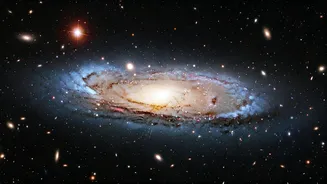
Recent observations have put forth an intriguing proposition: the universe might not be as uniform as once believed. Scientists are now pondering the possibility
of the universe displaying an inherent lopsidedness. The initial observations causing this paradigm shift originate from multiple independent studies, all of which suggest certain regions of space seem to exhibit properties that aren't consistently reflected across the cosmos. This could indicate a need to thoroughly review some of the foundational assumptions underpinning cosmological theories. The initial data hints at potential variations in the distribution of matter and energy across vast cosmic expanses, challenging the existing models of a homogeneously structured universe. It's an area of ongoing investigation, with researchers working intensely to analyze these discrepancies and comprehend their origin.
Challenging Cosmological Models
The evidence of an unbalanced universe, if confirmed, presents substantial problems for the current cosmological standard model. This model, which incorporates dark matter, dark energy, and the theory of inflation, is a cornerstone of our understanding of cosmic structure and evolution. The standard model presupposes a universe that, on a large scale, is homogeneous and isotropic, meaning it is uniform in all directions and has the same properties regardless of the observer's location. A lopsided universe contradicts this assumption, which would compel scientists to re-examine the validity of the current theories and develop new ones to account for the asymmetry. This could lead to revisions in our understanding of fundamental physical constants and the laws governing the universe's formation and expansion.
Potential Causes Explored
Researchers have started investigating possible explanations for this cosmic lopsidedness. One suggestion includes the early universe's inflationary epoch, during which tiny quantum fluctuations were magnified to create the structures we see today. Any asymmetry present during this period could have left an imprint on the cosmic web, resulting in the uneven distribution of matter observed now. Another hypothesis involves interactions among dark matter particles or variations in the distribution of dark energy, possibly influenced by previously unknown cosmic forces. As researchers probe deeper, they are using advanced simulations and mathematical models to investigate various scenarios. By doing this, they aim to pinpoint the underlying causes of the asymmetry and refine their understanding of the universe's fundamental nature.
Implications and Future Research
The findings that the universe is possibly lopsided have wide-ranging consequences. This research affects not just cosmology but also our understanding of fundamental physics. It raises questions about the very nature of space, time, and the forces that govern the cosmos. Future research will focus on gathering more comprehensive data, analyzing the existing observations using new methods, and developing advanced models. Telescopes and space-based observatories will play a vital role, helping scientists collect more light data from distant galaxies. These data will be used to map the cosmic web in greater detail. Further studies will help refine our understanding of the early universe and how it has shaped the cosmos we observe today. Ultimately, this research aims to redefine our comprehension of the universe's structure, evolution, and future.
Unveiling Cosmic Secrets
The possibility of a lopsided universe marks an exciting period in cosmology, pushing the boundaries of scientific understanding. The new data challenges our assumptions and sparks a need for deeper scrutiny of the laws that underpin the cosmos. As researchers unveil more information, new insights into the universe's structure and evolution are sure to emerge. This endeavor is a testament to the scientific process and the human curiosity that pushes us to explore the unknown. The implications of this research are substantial. They could eventually lead to new discoveries about the universe's origins, how it works, and how it will evolve.