







Europa's Intrigue
Europa, a celestial body orbiting Jupiter, has long captivated scientists because of its icy shell and the potential existence of a subsurface ocean. The
presence of water, a fundamental requirement for life, has made Europa a prime target for exploration. Recent studies have focused on the geological features of Europa, hoping to uncover clues about what lies beneath the surface. One particular feature, a spider-like scar, has become a focal point of investigation. This intriguing pattern on the moon's surface could be a vital clue to the existence of a vast, salty ocean that might exist beneath the icy surface. The research on Europa continues to evolve, promising new discoveries about this celestial body.
Spider Scar Unveiled
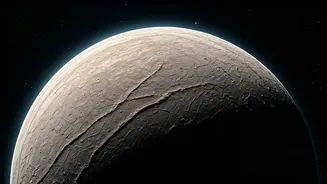
The 'spider scar' on Europa is a unique geological formation that has become a topic of considerable interest. It's not a single feature but rather a network of fractures and ridges that extend across a significant portion of Europa's surface, resembling the structure of a spider. The formation's complex nature has led scientists to speculate about its origins. One prominent hypothesis suggests that the scar is a product of geological activity, possibly related to the movement of subsurface water or the interactions between the ice shell and the internal ocean. Analyzing this pattern provides valuable insight into the moon's internal structure and the processes that shape its surface. Studying these formations helps researchers to improve understanding of Europa's history and its potential for habitability.
Subsurface Water Potential
The most significant implication of the spider scar's existence is the suggestion of a subsurface ocean on Europa. The presence of liquid water, beneath the ice shell, is a crucial ingredient for life. Scientists believe this ocean could be extensive, with the potential to house a habitable environment. The cracks and ridges forming the spider scar may be linked to the interaction of the ice shell with the subsurface ocean. The evidence to support the idea includes the fact that the fractures and ridges on Europa’s surface are likely connected to the ocean. Scientists believe that this connection could allow for the exchange of materials between the ocean and the surface. Understanding the nature and extent of this potential ocean is the aim of ongoing missions, that may provide the definitive answer.
Research Methods Applied
To analyze the spider scar, scientists employ various techniques. Remote sensing, which includes imaging and spectral analysis, is used to study the surface of Europa from orbit. These instruments can map the structure of the scar, identify the composition of surface materials, and detect subtle variations in temperature. This helps in understanding the geological processes at work. Besides remote sensing, scientists also create models. These models mimic the internal structure of Europa. This helps to investigate the potential mechanics of the spider scar's formation. Furthermore, the data collected from telescopes is combined with data from spacecraft. The research continues to gather insights and refine our understanding of Europa. This approach allows scientists to construct a more complete picture of the moon's complex environment.
Significance of Discovery
The discovery of a potential connection between the spider scar and subsurface saltwater has considerable implications. It strengthens the possibility that Europa is a habitable world. The presence of liquid water, alongside a source of energy and the right chemical compounds, creates the right ingredients for life. The presence of water boosts the possibilities for future investigations, including exploring the ocean directly. Furthermore, learning about the geological processes that formed the spider scar can help us to better understand the evolution of the solar system. The ongoing research into Europa helps expand the search for life. It may also lead to the reevaluation of our concepts of life outside Earth.
Future Exploration
The study of Europa is an ongoing process. Future missions are being designed to provide more data. These missions are planned to gather more detailed images of the surface and analyse the composition of the ice and any possible plumes of water vapor that might be released. The goal is to investigate Europa's subsurface ocean. These efforts include sending a spacecraft with instruments to directly sample the moon's environment. The missions are expected to provide more details about the presence of the spider scar. It is hoped that new observations can help us understand Europa's potential for habitability. With ongoing exploration, it is hoped that we can reveal the secrets of this mysterious moon.