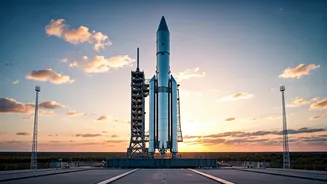

Rocket Moves Forward
NASA has transported the Artemis II rocket to its launch pad. This transportation is an essential preparatory step for the forthcoming mission. The move
signifies considerable advancements in the project’s progression and is a sign of anticipation for the mission. The program's development continues, demonstrating the space agency's commitment to achieving its lunar exploration goals. This initiative marks a crucial moment for the future of space exploration, highlighting the continuous advancements in rocket technology and mission readiness.
Crewed Moon Mission
The Artemis II mission signifies NASA's commitment to return humans to the Moon. The plan involves sending astronauts on a journey around the Moon. This crewed flight acts as an important stepping stone before a landing can be attempted. This crucial step is the key element for further ambitious projects, including a base on the lunar surface. The goal of Artemis II is to test key systems and procedures needed for human lunar missions.
Advancing Exploration Goals
The Artemis II program is not merely about landing people on the Moon; it's also about laying the foundation for future exploration. NASA plans to establish a long-term presence on the Moon, enabling extensive scientific research. Furthermore, the agency wants to use the Moon as a base for expeditions to Mars. These forward-thinking strategies are the core of Artemis, aiming for the expansion of human presence beyond Earth.
Future Mission Implications
The Artemis II mission also paves the way for commercial ventures in space. This initiative could open doors for space travel, research, and resource exploitation. The agency also focuses on worldwide collaboration in order to realize its ambitious goals. The mission has the potential to start a new era of space exploration, benefitting multiple industries and sparking international partnerships.