





Dimensions Compared
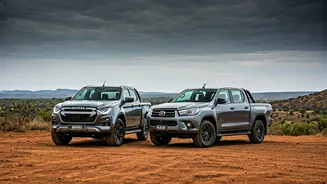
When looking at the physical presence of these two robust pickup trucks, there are subtle yet significant differences in their measurements. The Isuzu
V-Cross stands taller by 40mm and boasts a slightly longer wheelbase of 10mm more than its competitor. However, the Toyota Hilux edges out the V-Cross in overall length, being 30mm longer. In terms of width, they are remarkably close, indicating a similar footprint on the road. These dimensional disparities, though small, can influence maneuverability and interior space perception, contributing to the distinct character of each vehicle.
Engine Powerhouse Duel
Under the hood, both vehicles rely on diesel engines, but their configurations and outputs differ considerably. The Toyota Hilux is equipped with a more substantial 2.8-liter diesel engine, which translates into a significant advantage in both horsepower and torque. It produces 204 horsepower and 500 Nm of torque, outperforming the Isuzu V-Cross's 1.9-liter diesel engine which delivers 163 horsepower and 360 Nm of torque. Both trucks offer a choice between a 6-speed manual or a 6-speed automatic transmission, and both come equipped with a capable 4WD system, ensuring they are ready for diverse terrains.
Exterior Styling and Lighting
The external appearance of the Isuzu V-Cross and Toyota Hilux reveals distinct design choices, particularly in their lighting systems. Both feature auto-projector LED headlamps, but the Hilux goes a step further by incorporating full LED lighting for its fog lamps and tail lamps. The Isuzu, conversely, utilizes halogen bulbs for these specific lights. The Hilux also boasts rear fog lamps, a feature absent on the V-Cross. While the V-Cross comes standard with roof rails and side steps, these are offered as optional accessories on the Hilux. Both trucks ride on 18-inch alloy wheels and present a monotone exterior finish.
Cabin Comfort and Tech
Inside the cabin, the V-Cross presents a larger 10.3-inch infotainment touchscreen, surpassing the Hilux's 8-inch display, and also includes two extra speakers for an enhanced audio experience with its 8-speaker setup compared to the Hilux's 6. Both models feature automatic climate control, though the Hilux elevates the comfort with dual-zone functionality. The driver's seat in the Hilux offers more adjustment options with an 8-way powered seat, versus the V-Cross's 6-way powered seat. Additionally, the Hilux provides a cooled glove box. A notable difference in practicality lies in the rear seating: the V-Cross offers a flat-folding rear bench for increased cargo space, while the Hilux's rear seats can be flipped upwards.
Driving Technology and Drivetrain
In terms of advanced driving technology and off-road capability, both the Isuzu V-Cross and Toyota Hilux are well-equipped. They both feature a robust 4WD system with electronic differential locks and a low-range transfer case, ensuring strong performance on challenging terrains. The 4WD system in both is electronically controlled. Notably, neither model offers paddle shifters for the automatic transmission, maintaining a more traditional driver engagement. These shared functionalities underscore their shared purpose as capable lifestyle vehicles designed for adventure.
Safety Features Overview
Safety is paramount, and both pickup trucks offer a range of features, albeit with some key distinctions. The Toyota Hilux leads with seven airbags across its range, whereas the Isuzu V-Cross offers six airbags in its top variant, with the entry-level variant having two. While the V-Cross boasts a comprehensive 360-degree camera system for superior all-around visibility, the Hilux is equipped with a rear parking camera and front parking sensors. The Hilux also includes an auto-dimming interior rearview mirror. However, the Hilux omits a tyre-pressure monitoring system (TPMS), a feature present on the V-Cross. Both vehicles include essential safety aids like ABS with EBD and multiple airbags.
Price Point Comparison
The financial aspect of owning these lifestyle pickups reveals a significant divergence in pricing. The Toyota Hilux, carrying a premium brand legacy and enhanced specifications, is positioned at a higher price bracket, with its ex-showroom price ranging from Rs 28.02 lakh to Rs 35.37 lakh. In contrast, the Isuzu V-Cross offers a more accessible entry point into the lifestyle pickup segment, with prices starting at Rs 25.50 lakh and going up to Rs 30.28 lakh. This considerable price difference, especially at the top-end variants where the gap exceeds Rs 5 lakh, makes the V-Cross a more budget-friendly option that still delivers a substantial feature set.