



Shared Foundations Revealed
Despite their updated designations, both the standard 390 Duke and the 390 Duke R share a remarkably similar underlying structure. They both utilize the same
robust Gen-3 chassis, a design that combines a steel trellis main frame with a lightweight aluminium subframe, ensuring excellent rigidity and handling characteristics. The suspension system on both models is identical, featuring the acclaimed WP Apex USD front forks and a rear monoshock, tuned for a responsive and engaging ride. When it comes to braking, KTM has equipped both with the same formidable setup: a substantial 320mm front disc gripped by four-piston radial calipers, complemented by a 240mm rear disc with a twin-piston caliper. Furthermore, both bikes roll on the same lightweight wheels and maintain identical dimensions, including the wheelbase, ground clearance, seat height, and fuel tank capacity, promising a consistent rider experience in these crucial areas. Even the advanced electronic rider aids are shared across both variants, encompassing features like cruise control, launch control, multiple ride modes, traction control, cornering ABS, a bi-directional quickshifter, and the same vibrant 5-inch TFT display, offering a comprehensive suite of technology for safety and convenience.
Engine Power & Performance
The most significant divergence between the two KTM models lies under the fuel tank, specifically within their engine configurations. The latest iteration, now designated as the 390 Duke, features a re-engineered 349.3cc liquid-cooled single-cylinder engine. This unit achieves its smaller displacement through a reduction in stroke, resulting in a peak output of 41.5 horsepower at 8,600 rpm and 33.5 Nm of torque at 7,000 rpm. In contrast, the 390 Duke R, which carries over the larger engine from the previous generation, boasts a 398.6cc displacement. This larger engine delivers a more potent 46 horsepower at 8,500 rpm and a healthier 39 Nm of torque at 6,500 rpm. This translates to a performance advantage for the Duke R, offering 4.5 horsepower and 5.5 Nm more torque. Interestingly, both motorcycles maintain the same kerb weight of 168.3 kg, which means the 390 Duke R possesses a superior power-to-weight ratio due to its enhanced engine output, offering a more spirited acceleration and overall performance feel.
Visual Identity & Styling
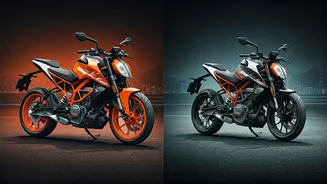
While the fundamental design and aggressive styling of both the 390 Duke and the 390 Duke R remain identical, their visual appeal is subtly differentiated through their color schemes and graphic treatments. The standard 390 Duke is distinguished by its black finish on the frame and wheels, offering a more understated aesthetic. The 390 Duke R, however, sports a more vibrant look, with its frame and wheels finished in the brand's signature orange hue. Beyond the frame and wheel colors, the graphics on the fuel tanks also serve to set them apart. The new 390 Duke prominently features '390' badging as its primary graphic element, emphasizing its updated identity. Conversely, the 390 Duke R places greater emphasis on the 'Duke' nameplate, with bolder graphics that highlight its performance lineage. These cosmetic differences, while not affecting performance, contribute to a distinct visual personality for each model.
Pricing & Value Proposition
The financial aspect presents a considerable distinction between the two models, directly reflecting their performance capabilities. The new KTM 390 Duke is positioned at Rs 2.77 lakh, while the 390 Duke R commands a price of Rs 3.39 lakh, both figures being ex-showroom prices in Delhi. This means the 390 Duke R is Rs 62,000 more expensive than its newly named sibling. Essentially, this premium price tag for the Duke R is paying for the enhanced engine performance, namely the increased horsepower and torque. Whether this additional investment is justified hinges entirely on the rider's priority for outright performance. For those who value the extra grunt and a more potent riding experience, the 390 Duke R offers a compelling upgrade. However, for riders whose priorities lie elsewhere, or for whom the performance difference is not a critical factor, the standard 390 Duke presents an attractive proposition. It delivers the same advanced chassis, sophisticated suspension, potent braking system, comprehensive electronics, and desirable features at a significantly more accessible price point, making it a strong contender for those seeking value without compromising on the core KTM riding experience.