





Amritsar to Attari
Journey just 25 kilometers from Amritsar to Attari, a route steeped in history and offering glimpses of the India-Pakistan border. For a mere ₹10 and about
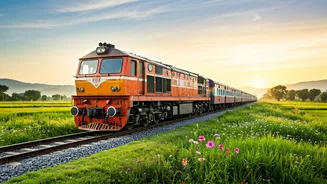
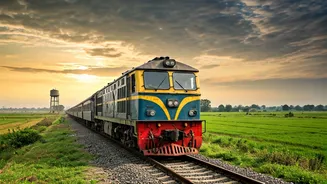
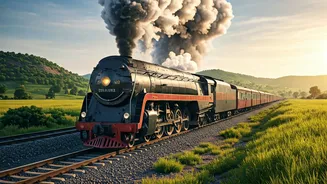
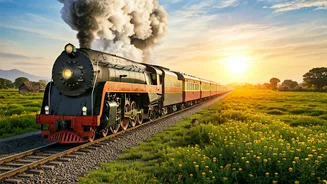
40-45 minutes, this short trip passes through Chheharta and Khasa, culminating near the international frontier. Historically, this railway line was a vital link to Lahore before the partition of India. The landscape unfolds into expansive green fields dotted with small villages, and one might even see Border Security Force training exercises near Khasa. Attari station itself is a relic of the colonial era, complete with an international platform that once facilitated cross-border travel. The main draw here is the renowned Attari-Wagah border ceremony, with nearby attractions including Sarai Amanat Khan village, Pul Kanjri built by Maharaja Ranjit Singh, and Sham Singh Attari Park housing a museum dedicated to the Sikh general. Trains depart Amritsar at 07:30 am and 06:20 pm, with return services from Attari at 08:20 am and 07:15 pm.
Amritsar to Dera Baba Nanak
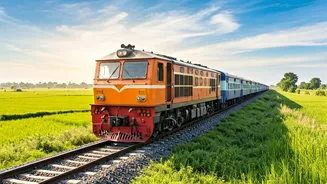
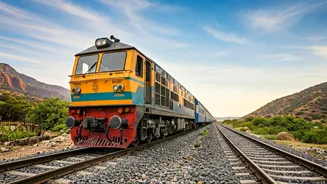
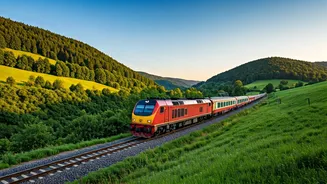
Embark on a serene 55-kilometer voyage from Amritsar to Dera Baba Nanak, a journey taking approximately 1 hour and 20 minutes for just ₹15. This route makes several stops, including Verka, Majitha, Ramdas, Rattar Chattar, and Hardowal, before reaching the revered town in Gurdaspur district. The stations along this path are adorned with charming colonial-era architecture, often embellished with vibrant bougainvillaea. Verka station presents a picturesque bungalow-like appearance reminiscent of hill stations, while Hardowal offers a tranquil rural ambiance. From the train windows, one can observe agricultural activities, tractors tilling vast fields, and villagers engaged in their daily work across the picturesque countryside. Dera Baba Nanak holds profound religious significance as the place where Guru Nanak Dev Ji spent his final years. This town is situated across the Ravi River from Kartarpur in Pakistan, which is home to the revered Gurdwara Darbar Sahib Kartarpur. Travelers can access the Kartarpur Corridor from here, enabling Indian Sikh pilgrims to visit the shrine in Pakistan visa-free when it is operational. Other significant sites include Darbar Sahib gurdwara, Sri Chohla Sahib, and the local bazaar. Trains run from Amritsar/Verka to Dera Baba Nanak at 04:20 am, 10:30 am, 02:15 pm, and 05:50 pm, with return services at 06:05 am, 12:15 pm, 04:00 pm, and 07:20 pm.
Amritsar to Khem Karan
Undertake the most extensive of the three routes, covering 77 kilometers from Amritsar to Khem Karan in approximately two hours for ₹20. Some services originate from Bhagtanwala station near Amritsar, winding through numerous small halts in the Taran Taran district, providing an intimate view of rural Punjab. Khem Karan is historically momentous, serving as the site of the pivotal Battle of Asal Uttar during the 1965 Indo-Pakistani War. Indian forces successfully thwarted a significant Pakistani armored offensive here, a victory that led to numerous abandoned tanks littering the fields, earning the area the moniker 'Graveyard of Tanks'. Nearby, close to the border fence, are two unique religious sites: Gurdwara Sahib Singh Shaheed and Sheikh Braham Dargah. Access to these sites requires passing through Border Security Force checkpoints. Strict regulations are in place, including the mandatory deposit of electronic devices and a prohibition on photography in the vicinity. Train services depart Amritsar/Bhagtanwala for Khem Karan at 04:40 am, 09:15 am, 01:35 pm, and 06:10 pm, with return trips scheduled for 06:50 am, 11:25 am, 03:35 pm, and 08:10 pm.
Cinema and Changing Seasons
The railway line connecting Amritsar and Attari has graced the silver screen, notably featuring in 'Bajrangi Bhaijaan' to underscore the emotional bond between India and Pakistan, and Attari station itself was a filming site for 'Veer-Zaara,' a tale of cross-border love. The serene, frontier-bound railway line continues to evoke sentiments of separation and remembrance. Dera Baba Nanak's humble railway station has also attracted cinematic attention, appearing in 'Gustaakh Ishq,' celebrating the charm of small-town Punjab and its vintage railway architecture. Traveling these routes during winter mornings offers a particularly enchanting experience. Dense fog often blankets the fields around Amritsar and Attari in December, softening the landscape into a serene blend of grey and green. As the train progresses, vast farmlands, distant hamlets, and expansive skies create a tranquil panorama that slowly unfurls outside the carriage windows.
Border Shrines & Heritage Stations
The sacred shrines situated near Khem Karan are positioned exceptionally close to the international border, necessitating stringent security procedures before entry. Visitors are required to pass through Border Security Force (BSF) checkpoints and present valid identification. All electronic gadgets, including mobile phones and cameras, must be surrendered to the BSF prior to accessing the shrine area, and photography is strictly prohibited along the border fence. Many of the railway stations along these routes still proudly display their colonial-era architectural heritage. However, some historically significant structures, such as the former stations at Chheharta and Khasa on the Attari route, have unfortunately fallen into disrepair or have been demolished. The remaining original buildings, especially those found along the Dera Baba Nanak line, remain visually striking and hold potential for restoration as valuable heritage attractions, offering a tangible link to the past.