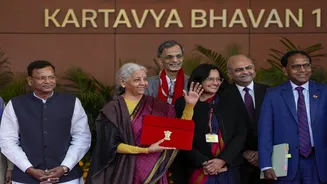

New Delhi: The Union Budget 2026–27 has placed the youth of the country at the centre of the growth strategy through the ‘Yuva Shakti’ vision. Announced
for the first time in Kartavya Bhawan, the budget focuses on turning students into skilled professionals for modern enterprises, global services, and emerging industries.
Inspired by the Viksit Bharat Young Leaders Dialogue 2026, the budget introduces wide-ranging reforms across education. The ultimate aim is to form a smooth and practical transition from classrooms to careers by modernising curricula, expanding professional training, improving education infrastructure and using technology to open new job opportunities and income.
Bridging education, employment
To keep education pace with changing job markets, the government has set up a High-Powered Standing Committee on Education to Employment and Enterprise which will redesign curricula so that skills taught in classrooms match global industry requirements. The committee will closely track the impact of artificial intelligence on jobs and ensure students are trained in future-ready skills rather than outdated roles.
The committee will also help workers convert informal experience into formal qualifications allowing to enter the organised professional economy. This move is expected to strengthen India’s services sector and create clear career pathways for young learners.
Major push to healthcare education
Healthcare education and employment are the major points of focus in the budget. By upgrading existing institutes, the government has proposed to train one lakh new Allied Health Professionals (AHPs) over the next five years. The training will be provided in fields such as optometry, radiology, anaesthesia, OT technology, applied psychology and behavioural health.
In addition, the budget proposes training 1.5 lakh caregivers through multi-skilled programmes covering geriatric care, wellness, yoga and the use of medical and assistive devices. To strengthen healthcare infrastructure, the government will establish three new All India Institute of Medical Sciences (AIIMS) and three new All India Institutes of Ayurveda. Five regional medical hubs will be established which will promote medical value tourism and generate new jobs for healthcare professionals, researchers and rehabilitation experts.
Boost to creative, design and digital education
AVGC Content Creator Labs will be set up in 15,000 secondary schools and 500 colleges across the country which will allow students from smaller towns to learn animation, gaming, visual effects and digital content creation without relocating to major cities.
Advanced training opportunities will be offered through the Indian Institute of Creative Technologies in Mumbai and a new National Institute of Design in the eastern region.
University townships, girls’ hostels
For the safety and proximity in education specificaly for women and STEM students the budget announces major infrastructure initiatives. One girls’ hostel in every district supported through viability gap funding and capital support has been proposed. There will also be five university townships near major industrial and logistics corridors. These townships will include universities, research centres, hostels and skill institutions in one area helping students gain practical exposure while living in safe and affordable accommodation.
Technology, AI, digital knowledge platforms
Initiatives such as the National Destination Digital Knowledge Grid will allow students and researchers to document and monetise India’s cultural, historical and regional knowledge. To help youths build careers in data management, digital content and heritage tourism, Bharat-VISTAAR will provide AI-based advisory support.
New opportunities in tourism, sports, hospitality
A pilot programme will train 10,000 tourist guides at 20 iconic sites through 12-week hybrid courses conducted by IIMs. New career paths are being promoted in eco-tourism, heritage storytelling, sports science under the Khelo India Mission and hospitality through the upgraded National Institute of Hospitality.