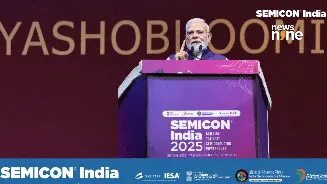









New Delhi: SEMICON India 2026 will be held from September 17 to 19 at Yashobhoomi in New Delhi, with Prime Minister Narendra Modi scheduled to inaugurate
the fifth edition of the semiconductor conference and exhibition. The event is being organised by the India Semiconductor Mission, the Ministry of Electronics and Information Technology and industry body SEMI.
The three-day event will bring together chipmakers, equipment companies, policymakers, startups, researchers and students from India and overseas. Organisers said more than 500 exhibitors, 294 international companies and over 150 speakers are expected to participate, along with delegations from more than 40 countries.
What to expect at SEMICON India 2026
This year’s theme is “Silicon to Systems: Building the Ecosystem”.
Sessions will cover semiconductor manufacturing, chip design, AI, digital transformation, supply chains, chemicals and materials, policy, startups, skilling and market development.
The exhibition will cover more than 15,000 square metres and include six country pavilions, 10 state government pavilions, a startup pavilion, a student hackathon and a startup pitch competition.
Companies expected at the event include ASML, Applied Materials, Infineon, NXP, Micron, Tata Electronics, Lam Research, Tokyo Electron, CG Power and several others.
Semicon 2.0 comes into focus
The event comes as the government moves ahead with Semicon 2.0, the next phase of India’s semiconductor programme.
MeitY Secretary S Krishnan said, “This year it is particularly significant for two reasons. Firstly, we are convening this event against the backdrop of the on-ground success of Semicon India Programme, with 03 of the 12 semiconductor projects approved under Semicon 1.0, having commenced commercial production.”
He added that Semicon 2.0 will have six major pillars.
The government said 12 semiconductor projects have been approved under Semicon 1.0. Design tools are being provided to more than 332 academic institutions and 105 startups, while 24 startups have been approved under the Design Linked Incentive scheme.
India eyes a larger semiconductor market
ISM CEO Amitesh Kumar Sinha said global semiconductor demand is expected to rise from around $1 trillion to $2 trillion. India’s requirement could grow from around $100 billion to $200 billion.