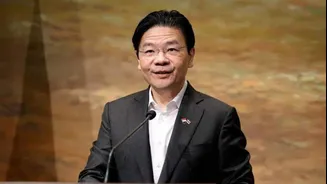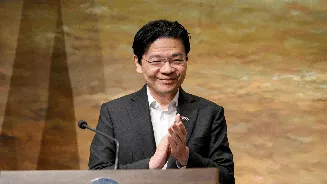









Singapore Prime Minister Lawrence Wong announced plans to significantly increase political salaries, with his benchmark annual pay set to rise from S$2.2
million to S$3.6 million.
The increase would take the salary benchmark to around Rs 27 crore, compared with the current equivalent of about Rs 16.5 crore. The deputy prime minister’s benchmark pay will increase from S$1.87 million to S$3.06 million, while cabinet ministers will receive between S$1.80 million and S$2.88 million depending on their seniority and responsibilities.
Wong promises to donate hike
Wong said he would donate the entire increase in his own salary to suitable charitable causes during his term.
The decision comes 15 years after Singapore last revised ministerial salaries. The government has long argued that high salaries are needed to attract talented people to politics and maintain effective governance.
However, the issue remains sensitive in Singapore because political salaries are significantly higher than the earnings of most citizens. “Political salaries are a difficult and emotive issue,” Wong said.
Wong acknowledged that Singaporeans would closely examine the proposed increases because of the large sums involved.
He argued, however, that the discussion should also focus on the quality of leadership needed to manage the country in the coming decades. “Our starting point is this: good government depends on good leadership,” he said.
Wong said the new salary structure was recommended by an independent committee. He also noted that the existing office holders would not immediately receive the full new benchmark salaries.
Current political office holders will instead receive a one-off adjustment of up to 9% from October 15, depending on individual circumstances and performance.
Further changes to their pay will also be linked to their responsibilities and individual performance, Wong said.
“Any subsequent changes will be based on individual performance and responsibilities,” said Wong.
Singapore regularly ranks among the world’s least corrupt countries, while the long-ruling People’s Action Party continues to dominate Parliament.
The government maintains that competitive salaries help Singapore attract and retain capable political leaders, despite the public debate over the high cost of political office.