







New Delhi: An international team of astronomers have identified two unusual exoplanets in orbit around a 15 million years old star designated as HD 114082.
For comparison, the Sun is 4.6 billion years old. The young star spins 15 times faster than the Sun, contains 28 per cent more mass, is about a thousand degrees hotter, and four times more luminous. The planets receive about 200 times more light and heat than Jupiter, despite their great distances to the host star. The research offers valuable new insights into the formation of exoplanets, and helps contextualise the Solar System.
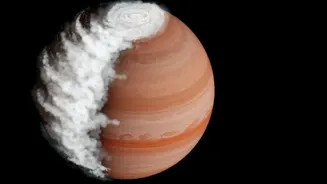
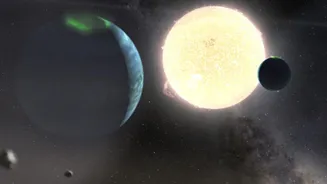
The pair of exoplanets stand out amongst the youngest detected exoplanets, because of how widely separated they are from their host stars. The inner planet is 20 per cent closer to its host star than the Earth, and is about the same size as Jupiter. The outer planet is at around the same distance from the host star as the Earth, and is about 36 per cent larger than Jupiter. Despite the size of the worlds, the planets are of such low densities, that they would float if there was an ocean large enough to drop them in. Both the exoplanets are in nearly circular orbits, in the same plane, and may be in or near an orbital resonance.
Follow-up observations planned
Scientists believe that these gas giants formed in the protoplanetary disc, from the gas and dust leftover from the birth of the host star. Once enough material was accumulated to form a solid core, they experienced a runaway gas accretion process, that increased internal heat and allowed the envelope to expand. The worlds could have formed in-situ, or migrated inwards after forming in the outer reaches of the star system. The astronomers hope to pinpoint the masses of the planets in more detail with future observations, as well as reveal the atmospheric chemical composition. A paper describing the research has been published in The Astrophysical Journal Letters.