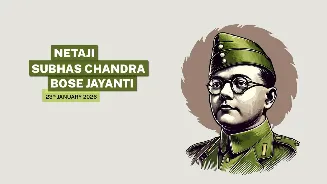

New Delhi: Picture this: it’s 23 January 2026, and India pauses to celebrate Subhas Chandra Bose Jayanti—better known as Parakram Diwas. Netaji, the man
who dared to dream of a free India when the odds were stacked sky-high, isn’t just a chapter in our history books; he’s the spark that reminds us what fearless leadership looks like. Born in 1897 in Cuttack, Subhas Chandra Bose rose from a freedom fighter’s son to a revolutionary icon, challenging even Mahatma Gandhi’s non-violent path with his unyielding call for action. His famous words, “Give me blood, and I shall give you freedom,” still echo in rallies and school assemblies today. As we mark his 129th birth anniversary, let’s dive into why Netaji’s story feels so alive in 2026—amid our fast-scrolling world of reels and protests. Have you ever wondered what drove a Cambridge-educated elite to ditch comfort for the battlefield?
This Parakram Diwas isn’t your average holiday; it’s a nationwide call to courage, honouring Netaji’s legacy of valour and self-reliance. From Kolkata’s bustling streets to Delhi’s memorials, celebrations light up with marches, speeches, and cultural programmes that make you feel the pulse of India’s independence struggle. Stick around as we unpack his epic tale, the grit that built his legend, life lessons for our chaotic times, and quotes that’ll inspire even the little ones. Ready to channel some Netaji energy this 2026?
Subhas Chandra Bose Jayanti 2026: Celebrating Parakram Diwas to honour the defiant spirit
Ever felt that itch to stand up when everything screams ‘sit down’? That’s the vibe of Subhas Chandra Bose Jayanti 2026, officially Parakram Diwas since 2021. Declared by the government, this day on 23 January celebrates Netaji’s birth and his philosophy of ‘Parakram’—pure courage in action. Schools host quizzes, offices run patriotism workshops, and streets fill with tricolour flags. In 2026, expect virtual events too, blending tradition with tech. It’s not just history; it’s a reminder: what bold step will you take today?
Untold story of Subhas Chandra Bose: From rebel student to Azad Hind Commander

Born on 23 January 1897 in Cuttack, Odisha, to a Bengali family, young Subhas was a sharp kid, topping exams and idolising Swami Vivekananda. He aced the Indian Civil Service exam in 1921 but quit the cushy job after Gandhi’s Non-Cooperation Movement kicked off. “Bureaucracy can’t quench my thirst for freedom,” he said, diving headfirst into politics.
By 1923, he’d formed the youth wing of the Congress, but clashes with moderates led him to start the Independence League. Arrested multiple times—house arrest in 1932, jail in 1934—he pulled off daring escapes, like dressing as a Pathan to flee Calcutta in 1941. In Europe, he linked up with Nazis but the real game-changer was 1943: arriving in Singapore via German U-boat, he took over the Indian National Army (INA) from Rash Behari Bose. “You give me blood, I will give you freedom!” he thundered to 60,000 troops.
Netaji built the Azad Hind Government in exile, with its own currency, courts, and army. They fought alongside Japan against the British in Imphal and Kohima battles of 1944—heartbreaking losses, but they shook the Empire. Rumours swirl about his 1945 plane crash death in Taiwan even today.
Netaji’s personality and legacy: Charismatic storm that shaped the nation
Netaji wasn’t your textbook leader; he was a magnetic force—fiery, intellectual, and brutally honest. Cambridge-polished yet soldier-tough, he blended spirituality (influenced by Ramakrishna) with ruthless strategy. Troops adored him, calling him “Netaji” (Respected Leader). He was a feminist ahead of his time, appointing women like Captain Lakshmi Sahgal to lead the Rani of Jhansi Regiment—over 1,000 fierce fighters.
His legacy? Immense. The INA trials in 1945-46 sparked naval mutinies that crippled British rule, hastening independence in 1947. Posthumously, he’s Bharat Ratna material, with memorials like Kolkata’s Netaji Bhawan and Delhi’s India Gate statue. In 2026, his self-reliance mantra fuels Startup India and Atmanirbhar Bharat. Globally, he’s studied as an anti-colonial icon. But here’s the real talk: his authoritarian leanings and Axis alliances spark debates. Still, his legacy endures—undogmatic patriotism that asks: are we living as boldly?
Lessons from Subhas Chandra Bose Netaji for today’s hustle: Fearless living in 2026
Netaji’s life isn’t dusty history; it’s a playbook for our grind. First, dare to differ—he quit Congress twice, forging his path. In a world of groupthink on social media, question the echo chamber. Second, act with urgency; his “Delhi Chalo” wasn’t passive hope but boots-on-ground action. Apply it: chase that side hustle or fitness goal now.
Third, self-reliance over handouts—Azad Hind’s economy was bootstrapped. Amid 2026’s job crunches, skill up independently. Fourth, lead with empathy; he cared for soldiers like family, even in defeat. Finally, stay unbreakable—escapes, arrests, wars didn’t dim his fire. Facing burnout or failure? Channel Netaji: resilience wins. What’s one lesson you’ll try this Parakram Diwas?
Iconic Subhas Chandra Bose quotes for children (and us all)

-
“Life loses all significance if we take away the passion for freedom.”
-
“Give me blood, and I shall give you freedom!”
-
“No real change in history has ever been achieved by discussions.”
-
“Soldiers who always remain faithful to their nation, who are always ready to sacrifice their lives, are immortal.”
-
“Freedom is not given, it is taken.”
-
“Let me tell you, the negligible number of youth in our country are full of fire.”
As Subhas Chandra Bose Jayanti 2026 unfolds, let’s honour Netaji not with speeches alone, but by igniting our own parakram. His legacy calls us to rise—fearless, united, free. Jai Hind!