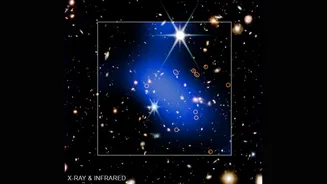




New Delhi: Astronomers have detected an X-ray emitting protocluster, designated as JADES-ID1 at a redshift of about 5.7, just one billion years after the
Big Bang. Protoclusters like JADES-ID1 were the progenitors of the massive galaxy clusters we see in the local universe, with galaxies embedded in hot gas, shining in energetic X-ray wavelengths. The discovery surpasses the previous record holder, observed three billion years after the Big Bang. Models suggest that there was insufficient time and galaxy density for such large proto-clusters to form so rapidly after the Big Bang. The discovery suggests that in some regions of the Universe at least, large-scale structures were assembled more rapidly than predictions.
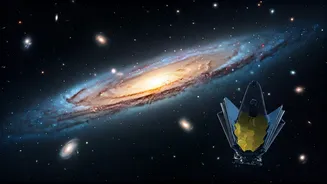
The discovery challenges the conventional theories on the evolution of the early universe. The protocluster was identified by combining observations of Chandra and Webb in the Jades field, that overlaps with the Chandra Deep South Field, which is the deepest X-ray survey ever conducted. The unique overlap allowed for the detection. There are five other protocluster candidates in the same field, but only JADES-ID1 has galaxies surrounded by hot, shock-heated gas detectable in X-rays. The overdensity of the cluster is 4.5 times the average field within a distance of 135 kiloparsecs.
Implications for Cosmic Evolution
The improbability of finding such a massive halo in the small surveyed volume implies an accelerated formation process for early galaxies. Theoretical predictions estimate only a few dozen such systems across the observable universe at that epoch, making the detection statistically rare. The discovery may indicate that there is a shortcoming in standard comsological models, similar to the discovery of an overabundance of luminous galaxies at higher redshifts. Whenever a novel object is discovered in space, additional similar discoveries follow. More early proto-clusters may be spotted in the future, that will help refine our understanding of cluster assembly in the early universe, as well as the intracluster medium.