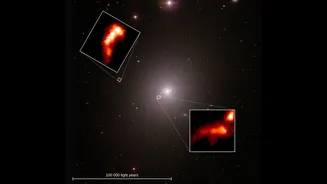







New Delhi: An international team of astronomers have captured the most detailed and complete view of mysterious filaments surrounding the giant galaxy
M87. Located at a distance of about 55 million lightyears, M87 is a supergiant elliptical galaxy, best known for the extremely active supermassive black hole that occupies its core. The new observations conducted by ground-based telescopes reveals that the galaxy is surrounded by long, thread-like structures that move, evolve and interact with the galactic environment, as well as activity of the central supermassive black hole. This supermassive black hole contains 6.5 billion solar masses, and has been imaged by the Event Horizon Telescope, that revealed its shadow for the first time.
M87 is a at the centre of the Virgo galaxy cluster, a gigantic system containing thousands of galaxies. These galaxies are immersed in a hot, diffuse intracluster gas that reaches tens of millions of degrees. Like many central galaxies, M87 is threaded by a complex network of thin filaments, stretching great distances from its centre. Despite decades of study, the origin of these filaments are unknown, and how they can survive in the harsh environment of a galaxy cluster is also unknown. M87 is the closest known galaxy to host such filamentary structures.
Filaments linked to present and past activity
The astronomers were able to determine the motions, compositions and connections of the filaments to the surrounding environments. Previous studies had indicated that the filaments near the galaxy core were stirred by the powerful polar jets from the black hole. The new observations reveal that these filaments are also stirred by smaller local motions, caused by explosions of old stars, that are common throughout the galaxy. The researchers also discovered that the detached outer filament moves in a more steady, uniform way, and appears to be linked to an earlier jet from a past period of black hole activity. The composition of the gas within the filaments also vary. A paper describing the research has been published in the Monthly Notices of the Royal Astronomical Society.