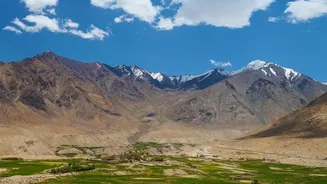




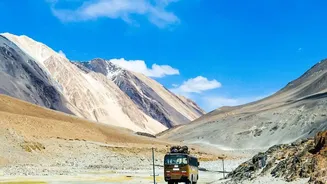


New Delhi: There are few places in India where spotting a wild animal requires quite so much patience – and quite so much altitude. Somewhere beyond the
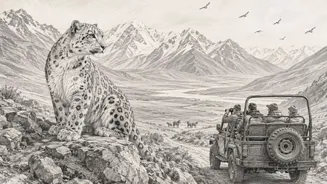
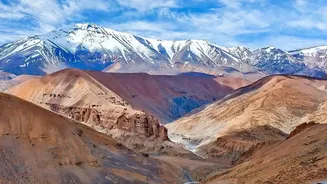
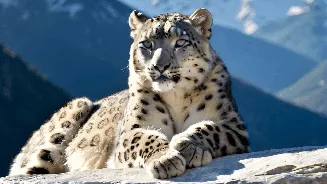
stark brown mountains, frozen valleys and vast blue skies of Ladakh, a snow leopard can disappear into a rock face so completely that even a trained eye may miss it. Now, the elusive “ghost of the mountains” is set to become the centrepiece of a new kind of wildlife experience. Ladakh has approved the introduction of India’s first high-altitude wildlife safari, a structured, guided safari initiative that will cover snow-leopard habitats and birding landscapes across the Union Territory.
The move, approved by the Ladakh administration on August 6, is being positioned not merely as a new tourism attraction but as an attempt to bring increasingly popular wildlife tourism under a more controlled and conservation-oriented framework.
Ladakh set to launch India’s first high-altitude wildlife safari
Unlike the conventional jeep safaris familiar to visitors to tiger reserves in central and northern India, Ladakh’s proposed safari will operate in a dramatically different environment: the high-altitude Trans-Himalaya.
Lieutenant Governor Vinai Kumar Saxena has directed the Forest Department to work towards introducing guided jeep safaris, broadly along the lines of wildlife tourism models used in parks such as Kaziranga and Ranthambore. The proposed vehicles will be specially designed open-back vehicles, operated by trained local drivers and accompanied by guides.
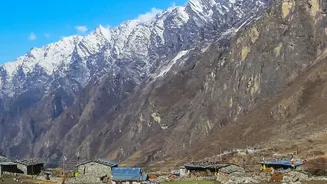
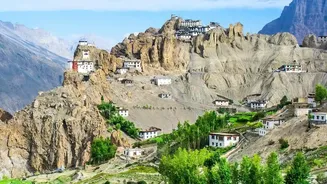
The planned safari network is expected to cover areas including Nubra, Zanskar, Sham, Kargil and Drass, all of which are known for high-altitude wildlife and bird diversity. Authorities have also been asked to explore suitable safari routes in Hemis National Park, Changthang Wildlife Sanctuary and the Karakoram (Nubra-Shyok) Wildlife Sanctuary.
The emphasis, therefore, is not simply on finding a snow leopard. The broader idea is to showcase Ladakh as a high-altitude wildlife landscape – one that includes rare mammals, birds and other species adapted to one of the world’s harshest environments.
Why snow leopards make Ladakh the perfect setting
The numbers explain why the snow leopard is at the centre of the initiative.
India’s first systematic nationwide Snow Leopard Population Assessment, conducted between 2019 and 2023, estimated 718 snow leopards in the country, with 477 in Ladakh alone – the highest population recorded in any Indian state or Union Territory. The assessment covered about 120,000 sq km of potential habitat and more than 70% of the species’ estimated range in India.
The Wildlife Institute of India’s assessment identified 126 individual snow leopards through camera-trap work in Ladakh and estimated the region’s population at 477.
That makes Ladakh arguably India’s most important landscape for experiencing the species in the wild.
The snow leopard, scientifically known as Panthera uncia, is listed as Vulnerable on the IUCN Red List. Its survival is closely tied to the health of high-altitude ecosystems, while habitat degradation, loss of prey, human-wildlife conflict, poaching and climate change remain significant threats.
A safari designed around local participation
One of the more significant aspects of the initiative is its focus on local employment.
The administration has said that 20 local youths will be appointed and trained in birdwatching, bird identification and wildlife-spotting skills, with the necessary equipment provided to them.
That approach fits into a broader move towards community-led tourism in Ladakh.
In June, the UT administration approved the constitution of the Snow Leopard and High-Altitude Nature (SHAN) Conservation Society, intended to provide a dedicated institutional mechanism for wildlife conservation, scientific management and community participation. The society is also tasked with supporting eco-tourism and sustainable livelihood opportunities in snow-leopard landscapes.
The thinking is straightforward: if local communities can earn from protecting wildlife and guiding visitors, conservation becomes more directly connected to livelihoods.
From snow leopards to Himalayan brown bears and rare birds
The proposed safari is not expected to be a one-species experience.
Ladakh’s official wildlife-tour regulations list a remarkable range of high-altitude mammals, including the Himalayan brown bear, Pallas’s cat, Eurasian lynx, Tibetan wolf, Tibetan antelope, wild yak, Tibetan gazelle, Tibetan argali, Himalayan ibex, blue sheep, Ladakh urial, kiang and Tibetan red fox.
The birdlife is equally distinctive. Among the species highlighted in the UT’s guidelines are the black-necked crane, Tibetan snowcock, Himalayan snowcock, Tibetan sandgrouse, Tibetan lark, Saker falcon, upland buzzard, Ibisbill and lammergeier.
The administration says Ladakh supports more than 38 mammal species and around 340 bird species, along with approximately 1,800 vascular plant species.
When is the best time to see a snow leopard
For anyone hoping to turn the new safari into a snow-leopard expedition, timing will be crucial.
Ladakh’s wildlife-tour regulations identify November to April as the main period for snow-leopard tours. The winter months are particularly important because snow and colder conditions can bring prey species into areas where they are comparatively easier for trackers to locate — and consequently improve the chances of a sighting.
Other species follow different seasonal patterns. The guidelines identify spring and autumn as favourable periods for Himalayan brown bears, while birdwatching can be undertaken throughout the year. Pallas’s cats are also considered year-round possibilities, while Eurasian lynx tours are primarily conducted from November to April.
But there is one rule every visitor should remember: a safari can offer the opportunity to see a snow leopard; it cannot guarantee one.
The species is famous precisely because it is so difficult to spot. Its grey-white coat and rosette markings blend almost perfectly into the rocky mountain landscape, earning it the enduring nickname “ghost of the mountains.”
What visitors can expect
The administration has not yet announced a complete public-facing package covering launch dates, safari fees, booking procedures, vehicle capacity, fixed routes or daily operating schedules.
That is important because the August 6 announcement represents approval to introduce the safari, rather than confirmation that tourists can already book the experience.
Once operational, however, the model is expected to combine guided vehicle-based wildlife viewing with local naturalists and trained drivers, potentially opening up new structured wildlife circuits across Ladakh’s snow-leopard and bird-rich landscapes.
For travellers, the attraction is obvious: rather than treating Ladakh merely as a destination of monasteries, passes, lakes and adventure roads, the safari could establish the region as one of India’s major high-altitude wildlife destinations.