






New Delhi: Every year, towering effigies of Ravana go up in flames, Ramlila performances bring the Ramayana to life, and devotees celebrate the arrival
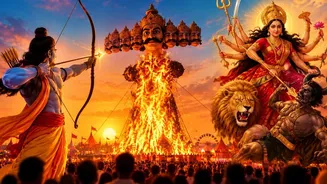
of Vijayadashami. But Dussehra is more than a festival ending with firecrackers and celebrations. It commemorates the victory of righteousness over destructive power through two distinct Hindu traditions: Lord Rama’s defeat of Ravana and Maa Durga’s triumph over Mahishasura.
Celebrated on the tenth lunar day of the bright fortnight of Ashwin, Dussehra is also known as Vijayadashami or Dasara. While North India prominently associates the occasion with the Ramayana, several eastern and southern traditions centre on the Goddess’s victory. Together, these stories give Dussehra its enduring message: power without righteousness cannot guarantee victory.
Why Is Dussehra Celebrated in India?
Dussehra celebrates the triumph of good over evil, but its significance extends beyond a single mythological victory. The festival represents the restoration of dharma, or righteous conduct, when arrogance, injustice and the misuse of power threaten the natural order.
In North India, Dussehra commemorates Lord Rama’s victory over Ravana, the king of Lanka who abducted Sita. In Bengal, Vijayadashami concludes Durga Puja, which celebrates Maa Durga’s defeat of Mahishasura. Karnataka’s Mysuru Dasara also places Goddess Chamundeshwari’s victory at the heart of its traditions.
These celebrations follow different mythological narratives and regional customs, yet they share the idea that destructive forces can be overcome and balance restored.
What Is the Story Behind Dussehra? Lord Rama’s Victory Over Ravana
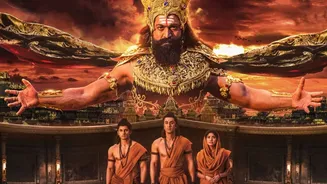
According to the Ramayana, Ravana abducted Sita and took her to Lanka. Lord Rama, accompanied by Lakshmana and supported by Hanuman and the vanara army, fought a decisive battle against Ravana’s forces to rescue her.
The conflict culminated in Rama defeating Ravana, bringing an end to the king’s rule and restoring righteousness. The story is remembered during Dussehra through Ramlila performances, public gatherings and the burning of Ravana’s effigy.
Ravana is a particularly complex figure in Hindu storytelling. He is portrayed as a powerful ruler and a learned devotee of Shiva, yet his abduction of Sita and refusal to correct his actions lead to his downfall. His story highlights how knowledge, strength and achievement cannot justify wrongdoing.
Dussehra therefore does not merely celebrate the defeat of an enemy. It also warns against allowing pride and power to override moral responsibility.
Why Is Dussehra Also Associated With Maa Durga’s Victory Over Mahishasura?
Dussehra is not defined by the Ramayana alone. In another major Hindu tradition, Vijayadashami celebrates Maa Durga’s victory over Mahishasura, a powerful demon who threatened the gods and the cosmic order.
According to the Devi Mahatmya, the combined divine energies of the gods manifested as Goddess Durga. Armed with celestial weapons and riding a lion, she fought Mahishasura and ultimately defeated him.
In this tradition, the Goddess embodies Shakti, or divine feminine power. Her victory represents the restoration of balance and the ability of divine strength to confront forces that threaten the world.
This narrative explains why Vijayadashami concludes Durga Puja in Bengal and why Goddess Durga remains central to several Dussehra celebrations across India.
Why Is Ravana Burned on Dussehra?
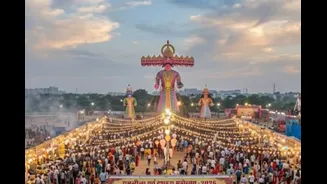
Ravan Dahan is among the most recognisable Dussehra traditions in North India. Effigies of Ravana, often accompanied by those of Meghnad and Kumbhakarna, are burned during public celebrations after episodes from the Ramayana are enacted.
The ritual represents the defeat of Ravana and the triumph of righteousness. It also turns the epic’s central conflict into a shared public experience, bringing communities together through theatre, storytelling and celebration.
However, burning Ravana’s effigy is not a universal Dussehra custom. Some regions celebrate Vijayadashami through Goddess worship, royal processions, traditional rituals or the immersion of Durga idols.
What Is the Spiritual Significance of Dussehra Today?
Dussehra continues to resonate because its stories invite reflection beyond their mythological settings. Rama’s victory highlights the importance of acting according to dharma even when facing difficult challenges. Maa Durga’s triumph represents the courage and strength needed to confront destructive forces.
The festival also reminds devotees that accomplishments alone do not make someone righteous. Knowledge without humility, authority without responsibility and strength without restraint can all become sources of downfall.
As Navratri concludes and Dussehra celebrations begin, the festival offers an opportunity to reflect on the values that shape everyday decisions.
Ultimately, Dussehra is celebrated not simply to remember two legendary victories, but to renew faith in righteousness, courage and accountability. Whether through the burning of Ravana’s effigy or the worship of Maa Durga, its central message remains enduring: true victory is achieved when power serves what is right.
Written by: Tanya Singh of Astropatri.com. For feedback, please write to hello@astropatri.com.