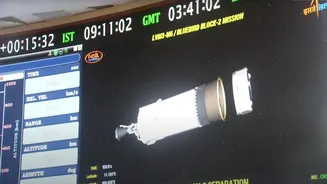







New Delhi: The Launch Vehicle Mark 3 (LVM3) has successfully deployed the first of the second generation ‘Block 2’ BlueBird communication satellites for
the US-based AST SpaceMobile. The successful injection of the satellite kicks off the intensive launch campaign by AST SpaceMobile that aims to deploy between 45 and 60 satellites by the end of 2026. There are five flights slotted for the first quarter of 2026, including launches by the Blue Origin New Glenn and the SpaceX Falcon 9. The satellites provide direct cellular broadband coverage to smartphones without the use of any modifications or special equipment. The 6,100 kg satellite was the heaviest launched from Indian soil.
Kudos Team #ISRO for the successful launch of LVM3-M6 carrying BlueBird Block-2.
With the visionary patronage of PM Sh @narendramodi, @isro continues to achieve one success after another, reiterating India’s growing prowess in Space technology. pic.twitter.com/gsnYimTwZs
— Dr Jitendra Singh (@DrJitendraSingh) December 24, 2025
After the successful deployment of the satellite, ISRO Chairman V Narayanan said, “I am extremely happy to announce that LVM3 ‘Baahubali’ rocket, M6 launch vehicle has successfully and precisely injected the BlueBird Block 2 communication satellite in the intended orbit. This is the first dedicated commercial launch for a customer from USA, that is AST SpaceMobile. Let me congratulate New Space India Limited (NSIL), the launch vehicle teams of the Department of Space (DoS), and the satellite project team of AST SpaceMobile on this outstanding achievement and contribution for the global community. This is our 104th launch from Sriharikota, also the ninth successful successive mission of the LVM3 launch vehicle, demonstrating its 100 per cent reliability.”
The reward for hard work is more work
This is the first time that two LVM3 launches have taken place within two months, demonstrating ISRO’s capacity of boosting its launch cadence. The back-to-back flights took place within an unprecedented 52 days. V Narayanan went on to explain, “This was not an easy task because of the enormous effort required very close coordination among various teams, at different ISRO centres, units, industry, launch complex and the entire infrastructure availability.” ISRO aims to round-off the year with the launch of the PSLV-C62 mission to launch DRDO’s EOS-N1 ‘Anvesha’ satellite with 11 co-passengers.