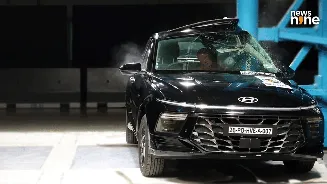








New Delhi: The 2026 Hyundai Verna has received a five-star safety rating from Bharat NCAP (BNCAP), making it one of the highest-rated sedans tested by
the Indian crash assessment programme. The evaluation covered the HX8 1.5 Turbo DCT and HX8 1.5 Petrol CVT variants, although the ratings apply to the entire Verna range.
While the sedan performed strongly in both categories, the frontal crash assessment highlighted marginal protection for the pelvis and thighs of the driver and front passenger. The Verna had previously secured a five-star rating in Global NCAP crash tests in 2023, when the pre-facelift model was evaluated.
Hyundai Verna Bharat NCAP AOP (28.22/32)
The Verna scored 12.45 out of 16 points in the frontal offset deformable barrier test and 15.77 out of 16 in the side movable deformable barrier assessment. During the frontal impact test, the driver’s head and neck received good protection, while the chest, tibiae and feet were rated adequate. However, protection for the driver’s pelvis and thighs was marked as marginal. The front passenger recorded a similar result for the pelvis and thighs.
The passenger’s head, neck, chest and left tibia received good protection, while the right tibia was rated adequate.
In the side impact assessment, the occupant’s head, abdomen and pelvis received good protection, while the chest was rated adequate. The Verna also performed well in the side pole impact test, with all critical body regions receiving a good rating. The overall assessment for this test was marked ‘OK’.
Hyundai Verna Bharat NCAP COP (44/49)

Verna scored 44/49 in Child Protection
The Verna achieved a perfect score in the dynamic child occupant protection assessment, securing 24 out of 24 points. It also received 12 out of 12 points for child restraint system (CRS) installation, while the vehicle assessment contributed eight out of a possible 13 points.
Bharat NCAP used child dummies representing 18-month-old and three-year-old occupants, both secured in rear-facing child seats. Each dummy received eight out of eight points in the frontal crash test and four out of four points in the side impact assessment.
Although the Verna secured maximum points in the dynamic and CRS installation categories, it lost five points in the vehicle assessment. This brought its overall child occupant protection score to 44 out of 49. The pre-facelift Verna underwent Global NCAP testing in 2023, where it also achieved five stars for both adult and child occupant protection. However, the scoring differed between the two assessments.
There were also differences in the protection assessments for certain body regions. In the frontal offset test, Global NCAP rated the driver’s chest protection as marginal, compared with an adequate rating in the Bharat NCAP assessment. The side impact results also varied. Global NCAP recorded marginal protection for the chest and adequate protection for the abdomen in the pole impact test. Bharat NCAP, meanwhile, rated these areas as receiving good protection.
Hyundai Verna safety features
The Hyundai Verna comes with six airbags as standard, alongside automatic headlights, a rear defogger, hill-start assist and a day/night inside rear-view mirror. Other standard safety equipment includes ISOFIX child-seat mounts, rear parking sensors, electronic stability control (ESC) and anti-lock braking system (ABS) with electronic brake-force distribution (EBD).
Higher trims even get advanced equipment, including a 360-degree camera, Level 2 advanced driver assistance systems (ADAS), a tyre pressure monitoring system (TPMS), front parking sensors and an electronic parking brake.