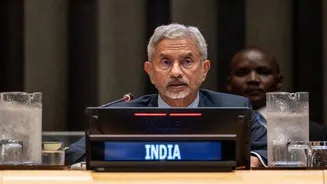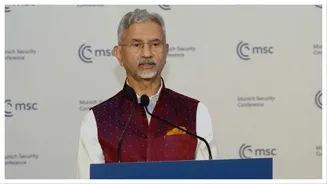







New Delhi: External Affairs Minister S Jaishankar on Sunday said the global landscape is undergoing a major shift with the United States taking a different
position in world affairs and China continuing to rise. He described Washington’s changing approach as a “radical repositioning” and said it was a “posture of choice”.
Speaking at the Munich Leaders Meeting in New Delhi, Jaishankar said the US had “deliberately become a lonelier power”. He said the change in America’s approach was one of the main factors shaping the current international order.
Jaishankar also pointed to China’s growing influence as another major feature of the changing global landscape. He said China’s economic strength was increasingly translating into political influence and described the competition between Washington and Beijing as increasingly sharp.
Jaishankar on US-China competition
The External Affairs Minister said the rivalry was no longer limited to the US and China. According to Jaishankar, countries are increasingly using whatever economic, political or strategic leverage they have as a tool in global competition.
“That competition today, not limited to these two countries, has led to a weaponization of any leverage that any country has,” he said.
#WATCH | Delhi: Speaking at the 62nd Munich Security Conference, External Affairs Minister Dr. S. Jaishankar says, “No one in the room would disagree with the fact that the landscape today is primarily marked by a radical repositioning of the United States. A repositioning which is a posture of choice and, in a way, it has deliberately become a lonelier power. The second feature of the landscape is, of course, the rise of China. China, which sees itself as a unique country that is in a way both its self-perception, in many ways, also the reality. And we are looking at very sharp competition. That competition today, not limited to these two countries, has led to a weaponization of any leverage that any country has. And that competition coexists with the complexity of interdependence.”
— ANI (@ANI) October 4, 2026
At the same time, Jaishankar said the rivalry exists alongside deep economic and political interdependence between countries. This, he said, has made the international situation more complicated.
Middle powers seek greater self-reliance
Jaishankar said emerging and middle powers were becoming more aware of their own interests and were looking for ways to become more self-reliant. He said these countries were also working on diversification and de-risking instead of depending too heavily on one partner.
He said countries were increasingly looking at what they could bring to the table during negotiations and international discussions. According to him, agenda-based cooperation is becoming more important as countries try to protect their interests.
Jaishankar also argued that countries do not need to have identical views on every issue to work together. A reasonable level of common ground, he said, can be enough for cooperation.
Quad, BRICS among new partnerships
Jaishankar cited the Quad, BRICS and several connectivity projects as examples of flexible cooperation. He also mentioned the India-Middle East-Europe Economic Corridor, the International North-South Transport Corridor and the Northern Sea Route.
He said emerging and middle powers could maintain ties with both the US and China while also cooperating among themselves, as long as there were no direct clashes of interest.
Jaishankar said this approach of de-risking, diversification and strategic hedging was gradually contributing to a new global architecture. Countries, he said, are increasingly forming partnerships based on specific interests rather than relying only on traditional alliances.