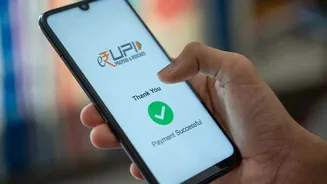









Kolkata: UPI MDR or Merchant discount rate will kick in from October 15. The rate will be 0.4% of the transaction amount above Rs 2,000 for person-to-merchant
(P2M) transactions. According to the new rules announced by the National Payments Corporation of India (NPCI), the maximum MDR for transactions of Rs 75,000 or more will be Rs 300. However, not all merchants will be charged the same. A flat MDR of Rs 5 has been set for certain categories, including railways, telecom, insurance, and fuel.
Why only Rs 5 on for railways, telecom, insurance and fuel?
According to the Finance Ministry, a flat MDR of Rs 5 will be applicable on transactions above Rs 2,000 for railway, telecom, insurance, fuel and some utility-type payments, i.e., irrespective of the transaction amount, the charge for these categories will remain Rs 5 only.
The reason behind this is that these sectors have a high volume of transactions, and in many cases, margins are limited or prices are controlled. Therefore, imposing a direct MDR of 0.4% could significantly increase the cost of accepting payments. A flat charge of Rs 5 is a way to keep costs within limits for these sectors. According to reports, the purpose of keeping a low fixed cap for sectors like Railways, Insurance, Fuel and Telecom is to keep essential services affordable and promote digital payments. In simple words, the reason is to prevent cost escalation.
How much benefit is there on UPI payment of Rs 2,000?
Suppose a UPI payment of Rs 2,000 is made. If a 0.4% MDR is applied, the merchant will have to pay Rs 8. In contrast, in the category with a Rs 5 cap, the charge will be only Rs 5, resulting in a savings of Rs 3 per transaction. Its break-even point is Rs 1,250, because 0.4% of Rs 1,250 is exactly Rs 5.
But it’s worth noting that the new MDR will only apply to transactions exceeding Rs 2,000. Therefore, the Rs 5 structure is more cost-effective for transactions within the chargeable range. For example, a Rs 10,000 payment would attract a normal 0.4% MDR of Rs 40, while a merchant in the discounted category would only charge Rs 5.
Can the merchant pass on MDR to the customer?
MDR is legally and operationally a merchant-side charge, meaning it is not designed to be a fee directly levied on the customer. The government has also advised banks to ensure that merchants do not pass on the new UPI charges directly to customers. However, the cost of accepting payments may be included in the total cost of business. Therefore, some merchants may absorb this directly, while others may pass it on indirectly through discounts, loyalty benefits, or other price changes.