
New Delhi: Between 2000 and 2025, India’s space operations evolved from an experimental programme to a reliable, regular operational space capability,
that has scientific, commercial and strategic roles. ISRO has closely followed the original vision of Vikram Sarabhao for the space agency, to use space technologies for the upliftment of the common man. In the early 2000s, ISRO was focused on making its launch vehicles reliable. The Polar Satellite Launch Vehicle (PSLV), now called the workhorse rocket, was at that time referred to as the war-horse rocket. PSLV has emerged as one of the most reliable launch vehicles in the world, regularly launching Earth observation, weather and scientific satellites.
The PSLV-C2 and C3 missions in 1999 and 2000 carried satellites for Germany, South Korea and Belgium, heralding commercial launches by ISRO. Over the 2000s, ISRO began developing heavier launch vehicles. The Geosynchronous Satellite Launch Vehicle faced repeated failures, and initially used cryogenic engines provided by Russia. On 5 January 2014, the GSLV-D5 mission lifted off with an indigenously developed cryogenic stage. This provided India with the capabilities for placing large communication satellites in geostationary orbit, for which India was previously relying on foreign launchers.
The growth of satellite applications
Satellite applications expanded steadily in India, with improvements in remote sensing for agriculture, disaster management, urban planning and defence. Communication satellites supported television, telecom and later broadband services. India also began building its own navigation constellation, initially called the Indian Regional Navigation Satellite System (IRNSS), which was later named Navigation with Indian Constellation (NavIC) which became operational in the late 2010s. The constellation is running on just four satellites, with ISRO aiming to deploy more satellites in the years ahead.
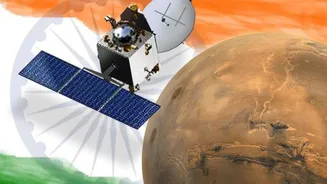
The historic Chandrayaan 1 mission confirmed the presence of water on the Moon in 2008, kickstarting an extremely successful lunar exploration programme. From 2010, ISRO moved into deep space and high-profile science missions, with the Mars Orbiter Mission in 2013 demonstrating interplanetary capabilties in combination with frugal engineering. India also launched its first dedicated space observatory, AstroSat in 2015. These missions demonstrated that India could plan, launch and operate complex spacecraft beyond Earth orbit.
The more powerful LVM3 rocket allowed for the launch of large satellites as well as flocks of small satellites. The space sector was liberalised in 2020 with policy reforms reshaping space operations. The government opened the sector to private companies, IN-SPACe (Indian National Space Promotion and Authorisation Centre) was created as a single window clearing agency for all space operations from India, ISPA (Indian Space Association) was founded as an industry platform to voice the aspirations of private companies operating in the space domain and New Space India Limited took over commercial launches.
Increasing role in space economy
ISRO developed its newest and smallest rocket, the Small Satellite Launch Vehicle specifically to cater to the demand for launching small satellites. New Space startups Skyroot Aerospace and Agnikul Cosmos both demosntrated their launch vehicle for small satellites in suborbital flights, and are now planning for their inaugural orbital flights in 2026. Startups in India are now deploying constellations of satellites, innovating on green propulsion technologies and developing advanced payloads. The focus has shifted from proving capabilities to sustaining operations for supporting national needs, and building a mixed public-private space ecosystem.