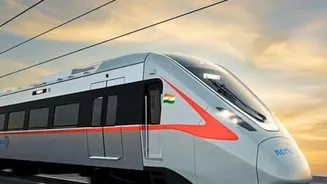








New Delhi: Four new Namo Bharat rapid rail corridors have been proposed for the Delhi-NCR region, including a route linking Ghaziabad with the upcoming
Noida International Airport. The National Capital Region Transport Corporation has submitted detailed project reports to the Centre for examination.
Union Minister of State for Housing and Urban Affairs Tokhan Sahu shared the development in a written reply in the Rajya Sabha. The proposals are still under review. Technical checks, cost studies and funding discussions will take place before any construction approval is issued.
Which new Namo Bharat routes are proposed?
The four corridors under consideration are:
- Delhi to Karnal
- Delhi to Bawal
- Bawal to Behror
- Ghaziabad to Noida International Airport
The Delhi-Karnal corridor could provide a faster public transport option for commuters travelling between the national capital and northern Haryana. At present, passengers mainly depend on highways and regular railway services.
The Ghaziabad to Noida International Airport corridor could become an important airport link. The new airport is being developed at Jewar and is expected to handle large passenger volumes. A direct rapid rail connection may help travellers from Ghaziabad and nearby parts of NCR reach the airport without long road journeys.
Why Delhi-Bawal and Bawal-Behror matter
The Delhi-Bawal and Bawal-Behror routes aim to improve connectivity across southern Haryana and towns located along the busy industrial belt.
People working in factories, offices and industrial areas often spend hours on crowded roads. A rapid rail service could cut travel time, though the final route, station list and project cost have not been approved yet.
How the corridors fit into the NCR rail plan
The NCR Planning Board had earlier identified eight Regional Rapid Transit System corridors under its transport plan for 2032. These included Delhi-Ghaziabad-Meerut, Delhi-Gurugram-Rewari-Alwar and Delhi-Sonipat-Panipat.
The Delhi-Ghaziabad-Meerut route was the first corridor to receive approval. The 82.15-kilometre line was sanctioned by the Centre in March 2019 and is now operating as India’s first Namo Bharat corridor.
What happens before construction starts?
The four proposed corridors have not received final approval or funding. Namo Bharat projects require large investments and usually involve the Centre, state governments and international lenders.
Each project will go through technical and financial checks. Authorities will study passenger demand, land needs, construction costs and expected revenue.