

New Delhi: Every year, as sisters tie the sacred thread of Rakhi on their brothers’ wrists, one of the most cherished stories associated with the festival
resurfaces – that of Lord Krishna and Draupadi. Their relationship was not one of biological siblings, yet Hindu tradition remembers it as a bond of extraordinary affection, trust and protection. From a small gesture of care to Krishna’s role in Draupadi’s hour of crisis, their story has come to symbolise a deeper idea of Raksha Bandhan: that the strongest bonds are sometimes created not by blood, but by love, loyalty and a promise to stand by each other.
When Draupadi tied a piece of her sari around Krishna’s finger
The story takes us to the time of the Pandavas and Krishna.
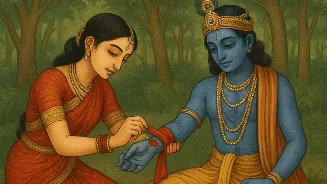
During a gathering at Indraprastha, Krishna injured his finger while using his Sudarshan Chakra against Shishupala. Blood began to flow from the wound.
Before anyone could attend to him, Draupadi noticed it.
Without hesitation, she tore a small piece from her sari and wrapped it around Krishna’s finger. It was a simple gesture. There was no ceremony, no sacred mantra and no rakhi in the way the festival is celebrated today. There was only affection — and the instinct to help someone she loved.
Krishna, touched by Draupadi’s gesture, is said to have promised that he would always stand by her and protect her whenever she needed him.
That little piece of cloth would become the symbol of a much greater bond. The promise found its most powerful meaning years later, in the Kaurava court.
After Yudhishthira lost the dice game, Draupadi was dragged into the royal assembly. Dushasana was ordered to disrobe her before the gathered elders and kings. Draupadi pleaded with those present to protect her. But the court remained largely helpless and silent. With no one else to turn to, she finally surrendered herself to Krishna and called upon him.
And then came the miracle that has lived in popular retellings of the Mahabharata for centuries.
As Dushasana pulled at Draupadi’s sari, the cloth did not end. He kept pulling, but the sari continued to flow. Yard after yard of fabric appeared, while Draupadi remained covered. Her honour was protected.
For devotees, this is where the Krishna-Draupadi story takes on its deepest meaning. The small piece of cloth Draupadi had once given Krishna in a moment of compassion had returned to her as an immeasurable shield of protection.
She had tied a piece of cloth around his wound. He, in turn, protected her when her dignity was under attack.
A bond beyond blood
Krishna and Draupadi were not siblings by birth. Their relationship was one of affection, trust and spiritual companionship, often described in tradition through the terms sakha and sakhi.
That is what makes their story particularly powerful in the context of Raksha Bandhan.
The festival is popularly understood as a celebration of the bond between brothers and sisters, but the Krishna-Draupadi legend gives the relationship a wider emotional meaning. A bond is not made sacred simply because two people are related by blood. It becomes sacred through care, trust and the promise to stand beside each other.
Draupadi did not tie a rakhi to Krishna on Raksha Bandhan. She simply helped him when he was hurt.
Yet tradition remembers that gesture as the beginning of a promise – one that Krishna honoured when Draupadi was at her most vulnerable.
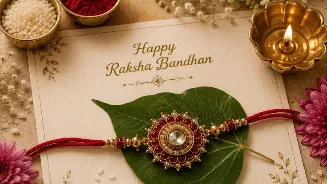
Every year, when a sister ties a rakhi around her brother’s wrist, the thread carries a simple message: I care for you, and I trust you to stand by me.
The Krishna-Draupadi legend gives that message an unforgettable image – a tiny piece of cloth offered with love and returned as an endless garment of protection. Perhaps that is why the story has survived for generations.