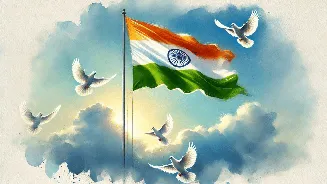






New Delhi: As India prepares to celebrate its 80th Independence Day on August 15, school students across the country are getting ready for flag-hoisting
ceremonies, cultural programmes and one of the most familiar rituals of the national festival – the Independence Day speech. But in 2026, a memorable speech need not stop at naming freedom fighters and repeating familiar patriotic lines. The strongest student addresses can connect India’s freedom struggle with the freedoms, responsibilities and choices that shape the country today.
There is something wonderfully democratic about an Independence Day school assembly. A student who may normally be sitting quietly at the back of a classroom suddenly stands behind a microphone, with the Tricolour fluttering above and an entire school listening. For a few minutes, history stops being a chapter in a textbook and becomes a question: What will our generation do with the freedom that earlier generations fought so hard to win?
Independence Day speech idea
Good morning respected Principal, teachers and my dear friends.
Today, as India celebrates its 80th Independence Day, we pause to remember the long and difficult journey that brought us freedom.
On August 15, 1947, India became independent after decades of resistance against British colonial rule. The freedom movement brought together people from different regions and backgrounds. Mahatma Gandhi’s mass movements, the courage of revolutionaries such as Bhagat Singh, the efforts of leaders such as Sardar Vallabhbhai Patel and Jawaharlal Nehru, the contribution of Subhas Chandra Bose and the Indian National Army, and the sacrifices of countless ordinary citizens all form part of this larger story.
But there is an important question we should ask today: What do we do with our freedom?
Freedom gives us rights, but it also gives us responsibilities.
As students, our responsibilities may appear small. We can respect people who are different from us. We can refuse to bully others. We can protect public property. We can learn about our history instead of simply memorising it. We can use technology responsibly and help create a society where everyone gets an opportunity to learn and grow.
India’s 100th year of independence will arrive in 2047. Many of us sitting here today will be adults then.
So the India of 2047 is not someone else’s responsibility. It will be our India.
Let us remember the sacrifices of the past, value the freedoms we have today and work towards a better tomorrow.
Thank you.
2-minute Independence Day speech for school
Good morning to our respected Principal, teachers, staff members and my dear friends.
Every year on August 15, the Tricolour rises above our schools, patriotic songs fill the air and we remember the men and women who fought for India’s freedom.
But perhaps the most important thing we can do today is pause and ask ourselves what that freedom actually means.
India became independent on August 15, 1947. That moment was the culmination of a long and complicated struggle against colonial rule. It was shaped by mass movements, political negotiations, acts of resistance, revolutionary activity and the sacrifices of people whose names are remembered — and of many whose names have disappeared from popular memory.
Independence was therefore not simply the lowering of one flag and the raising of another. It represented the beginning of a new responsibility.
India had to build a democracy, create institutions, protect its diversity and give its citizens a voice in determining their future. That responsibility has not disappeared.
Today, our challenges are different. We are no longer fighting colonial rule. We are confronting questions about education, employment, inequality, environmental sustainability, technology, misinformation and social harmony.
And this is where students enter the story. We are sometimes told that young people are the future of the country. But that is only partly true. Young people are also the present. Every time a student refuses discrimination, helps a classmate, checks whether information is true before sharing it, respects public property or speaks up against unfairness, that student is practising citizenship.
Patriotism does not have to be loud.
Sometimes patriotism is studying honestly. Sometimes it is keeping a street clean. Sometimes it is helping someone who has been excluded. Sometimes it is respecting a person whose language, religion, region or opinion is different from our own.
So, on this Independence Day, let us not merely ask what our country can do for us.
Let us ask what we can do – through our knowledge, character, courage and compassion — for the country we inherited and the country we will leave behind.
Short Independence Day speech
Good morning respected Principal, teachers and my dear friends.
Today, we proudly celebrate India’s 80th Independence Day. On August 15, 1947, India became free from British rule after a long struggle and the sacrifices of countless freedom fighters.
We remember great leaders like Mahatma Gandhi, Subhas Chandra Bose, Bhagat Singh, Sardar Vallabhbhai Patel and Jawaharlal Nehru, along with the many unsung heroes who fought for our freedom.
But Independence Day is not only about remembering the past. It is also about building the future. As students, we can serve our country by studying sincerely, respecting others, protecting our environment and becoming responsible citizens.
India will celebrate 100 years of independence in 2047. The India of that future will be shaped by the choices we make today.
Let us be proud of our country, respect our diversity and work together to make India stronger and better.
Happy Independence Day! Jai Hind!
For the generation growing up in 2026, Independence Day can be more than a ceremonial morning of flags, songs and speeches. It can be a reminder that the story of India is still being written – and that today’s students are already holding the pen.