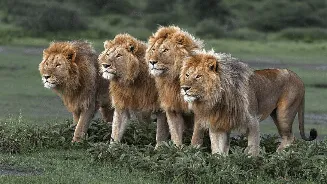









New Delhi: As the world celebrates the lion on August 10, India has a remarkable conservation story to tell. From a population that had been reduced to just
a handful of animals in the early 20th century to 891 Asiatic lions recorded in Gujarat in the latest 2025 estimation, the journey is extraordinary. But with lions now ranging far beyond Gir and more than half of Gujarat’s lions found outside the traditional protected landscape, the next chapter is about coexistence, habitat expansion and protecting the species from a single catastrophic event.
There are few wildlife encounters quite like this: the forest falls quiet, a few spotted deer suddenly freeze, the safari vehicle stops, and somewhere beyond the scrub comes the unmistakable presence of a lion. In most of the world, that moment belongs to Africa. In India, however, the story is different and far rarer. Here, the Asiatic lion has survived against extraordinary odds, reclaimed parts of its historic range and transformed Gujarat’s Saurashtra landscape into the last great refuge of a lion lineage that once stretched across Asia.
On World Lion Day 2026, observed on August 10, the spotlight therefore falls not merely on a charismatic big cat, but on one of India’s most remarkable conservation recoveries.
World Lion Day 2026: What is its history
World Lion Day is observed every year on August 10 to draw attention to lions, their shrinking habitats and the conservation challenges facing wild populations.
The day is widely credited to wildlife filmmakers and conservationists Dereck and Beverly Joubert, who worked with National Geographic and its Big Cats Initiative to raise awareness about the decline of big-cat populations. World Lion Day was established in 2013 and has since become an annual occasion for conservation organisations, governments and wildlife enthusiasts to focus attention on the species. National Geographic was already documenting the Jouberts’ lion-conservation work when the day emerged.
The symbolism of the day is particularly significant for India. While African lions remain far more numerous, India’s Asiatic lions represent a genetically distinct population whose wild existence is confined to Gujarat.
Best lion safaris in India in 2026
1. Gir National Park and Wildlife Sanctuary – the ultimate Asiatic lion safari
Location: Sasan Gir, Gujarat
If there is one place that belongs at the top of every Indian lion-safari list, it is Gir.
Gir is the historic stronghold of the Asiatic lion and remains the heart of the conservation story. The wider Gir landscape contains dry deciduous forest, scrub, grassland, rivers and reservoirs, supporting not just lions but leopards, chital, sambar, nilgai, chinkara, wild boar, crocodiles and hundreds of bird species.
2. Devalia Safari Park – the easier option for a lion sighting
Location: Devalia, near Sasan Gir
If Gir is the wilderness experience, Devalia Safari Park is the more controlled and accessible introduction to the Gir ecosystem.
Also known as the Gir Interpretation Zone, Devalia is a fenced 4.12-sq-km area created partly to reduce tourism pressure on the main Gir forest and provide visitors with a more predictable wildlife-viewing experience.
Gujarat Tourism currently describes lion and leopard sightings there as guaranteed, with 45-minute bus tours operating through the enclosure. Gypsy safari options are also available.
3. Girnar Nature Safari – lions against a dramatic hill landscape
Location: Junagadh, Gujarat
Girnar is one of the more unusual lion-viewing experiences because the wildlife landscape sits alongside one of Gujarat’s most important religious and geological landmarks.
The official Gir lion portal says the Girnar forest is home to more than 50 free-ranging Asiatic lions, alongside leopards, spotted deer, sambar, hyenas, crocodiles, jungle cats and more than 300 bird species.
4. Ambardi Safari Park – an alternative in the Gir landscape
Location: Dhari, Amreli district
Situated about 7 km from Dhari on the Shetrunji river, Ambardi Safari Park offers another way to experience Asiatic lions without relying entirely on the Sasan Gir circuit.
Gujarat Tourism describes Ambardi as part of the Gir Protected Area landscape and notes that the habitat supports Asiatic lions, leopards, chinkara, nilgai, spotted deer and other wildlife.
5. Barda Jungle Safari – the new lion destination to watch
Location: Barda Wildlife Sanctuary, Porbandar region
Barda is the most intriguing addition to Gujarat’s lion-tourism map.
Unlike the established Gir and Devalia experiences, Barda represents a conservation story that is still unfolding. The sanctuary’s lion population has grown from the natural arrival of a solitary male and subsequent conservation interventions to 17 lions recorded in the 2025 census.
The temptation on World Lion Day is to celebrate the number — 891 — and stop there.
But the more interesting story is what that number represents.
A century ago, the Asiatic lion was perilously close to disappearing from India. Today, its range has expanded across thousands of square kilometres of Gujarat, its population has grown sharply, and a new population has established itself at Barda.
Yet success has changed the nature of the problem.
The question is no longer simply “How do we save the last lions?”
It is increasingly “How do we make room for a growing lion population without putting either lions or people at unacceptable risk?”
That means securing corridors, protecting prey, managing roads and railway lines, responding rapidly to conflict, compensating livestock losses, maintaining veterinary capacity and perhaps most importantly ensuring that conservation remains a partnership with the communities living alongside the animals.