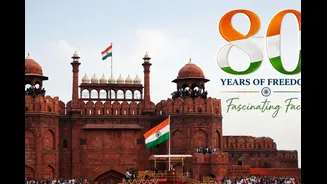





New Delhi: Every August, the Tiranga transforms ordinary balconies, rooftops and public spaces into a sea of saffron, white and green. But behind the familiar
flag is a remarkable story of experimentation, freedom struggle, political debate and national identity. As Har Ghar Tiranga 2026 gets underway, the Tricolour is once again at the centre of Independence Day celebrations, offering an opportunity to look beyond the flag on the pole and revisit how India’s most recognisable national symbol came to be.
History of Indian Flag
1. 1906 — Calcutta Flag
The first widely recognised flag associated with India’s nationalist movement was hoisted at Parsee Bagan Square, Calcutta, on August 7, 1906, during the Swadeshi movement. It featured horizontal green, yellow and red bands, with eight lotuses, “Vande Mataram”, and sun/crescent symbols.

2. 1907 — Berlin Committee / Bhikaji Cama Flag
In 1907, Bhikaji Cama and fellow revolutionaries carried a modified version abroad. It was raised in Paris and subsequently exhibited at a socialist conference in Stuttgart, Germany, which is why it is commonly associated with the Berlin/Stuttgart flag.

3. 1917 — Home Rule Movement Flag
The next major design emerged during the Home Rule Movement, associated with Annie Besant and Bal Gangadhar Tilak. It had alternating red and green stripes, seven stars representing the Saptarishi, the Union Jack in the canton, and a crescent and star.

4. 1921 — Pingali Venkayya’s Charkha Flag
At the 1921 Congress session at Bezwada (now Vijayawada), Pingali Venkayya presented a flag design to Mahatma Gandhi. The spinning wheel – or charkha became its defining feature, symbolising economic self-reliance and the freedom movement.

5. 1931 — Saffron, White and Green Charkha Flag
In 1931, the Congress formally adopted a modified version. The red was replaced by saffron, producing the saffron-white-green combination that would eventually become the foundation of the modern national flag. The charkha remained at the centre.

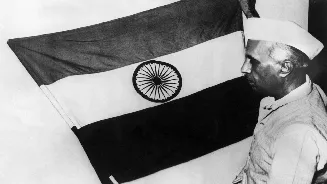
6. 1947 — The Tiranga we know today
Finally, on July 22, 1947, the Constituent Assembly adopted the National Flag of independent India. The charkha was replaced by the navy-blue Ashoka Chakra with 24 spokes, based on the Dharma Chakra associated with the Lion Capital of Ashoka at Sarnath.

From the freedom movement’s marches to today’s Har Ghar Tiranga campaign, the Tiranga has travelled far beyond its original role as a political symbol. It now represents the Indian republic itself—its sovereignty, aspirations and collective memory.
And that is perhaps the most enduring story of the Tricolour: a design born during India’s struggle for freedom became a symbol meant to belong to every Indian home.