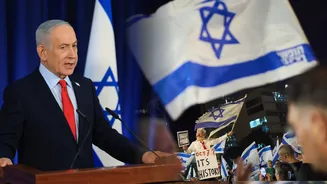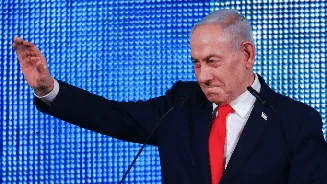







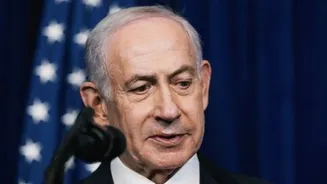

New Delhi: Israel’s parliamentary election has produced no clear winner, with nearly 90 per cent of votes counted. Prime Minister Benjamin Netanyahu’s
right-wing bloc is projected to win 53 seats, while the opposition bloc led by former military chief Gadi Eisenkot is expected to secure 48 seats in the 120-member Knesset, Israel’s parliament.
The results leave both sides short of the 61 seats required to form a government. Arab-led parties, meanwhile, are projected to win a combined 19 seats, putting them in a potentially important position in the negotiations that follow the election.
The final outcome is still awaited, with hundreds of thousands of special ballots, including votes cast by soldiers and diplomats, yet to be counted. The remaining votes could change the seat distribution, but the preliminary results point to a difficult process of government formation.
Why has the Israel election resulted in a deadlock?
Israel follows a parliamentary system in which voters elect political parties to the Knesset. The country has 120 parliamentary seats, and a party or group of parties needs the support of at least 61 lawmakers to command a majority and form a government.
Unlike a presidential election, the prime minister is not elected directly by voters. Instead, the leader who can secure enough support in parliament gets the opportunity to form the government.
No single party has ever won an outright majority in Israel. Governments are generally formed through coalitions, in which several parties agree to work together and support the prime minister.
In the current election, Netanyahu’s Likud party and its right-wing and ultra-Orthodox allies are projected to win 53 seats. Eisenkot’s opposition bloc is expected to secure 48. Neither has enough seats to form a government on its own.
The results are a setback for Netanyahu’s coalition, which held a larger parliamentary majority before the election. However, the prime minister has not been decisively defeated and could still attempt to put together a government through negotiations with other parties.
Netanyahu will remain caretaker prime minister until a new government is formed. If the parties fail to reach an agreement, Israel could face another election.
How could Arab parties influence the formation of the next government?
Arab-led parties have emerged as a significant factor in the election, with the Joint List and Ra’am projected to win a combined 19 seats. This would be a record showing for the parties and a substantial increase from their representation in the outgoing parliament.
Their seats could help an opposition-led government cross the 61-seat threshold. However, this would require cooperation between parties that have not all been willing to work with Arab-led groups.
Netanyahu has rejected the prospect of relying on Arab parties to form a government. Eisenkot, his main challenger, has also faced political constraints, with several parties in his opposition bloc previously ruling out cooperation with the Arab-led groups.
The Joint List has indicated that it could support efforts to remove Netanyahu from power without necessarily joining the government. This could allow an alternative administration to seek parliamentary support from Arab lawmakers while keeping them outside the cabinet.
However, the negotiations remain uncertain. The final seat count, the positions taken by individual parties and their willingness to compromise will determine whether either side can assemble a majority.
For now, the results have left Israel facing a political deadlock, with neither Netanyahu nor Eisenkot assured of forming the next government.