






New Delhi: October in Delhi-NCR can feel like a welcome change. The sticky monsoon humidity begins to ease, mornings slowly become more pleasant, and the
festive season gets underway. But this transition also marks the beginning of a less pleasant annual shift: the air starts getting dirtier.
Delhi has already seen signs of that change this October. After rain and stronger winds helped keep pollution levels relatively low in late September, air quality began deteriorating as rainfall reduced and weather conditions changed.
But why does the air often seem to change so quickly after the monsoon?
It is not simply because pollution suddenly appears in October. Delhi-NCR produces pollution throughout the year. What changes after the rains is the atmosphere’s ability to wash away and disperse those pollutants.
The monsoon acts like a temporary cleaner
Rain does more than cool the city. It can remove some airborne particulate matter from the atmosphere, while the stronger winds and greater atmospheric mixing associated with the monsoon can help disperse pollutants.
That is one reason a rainy day can sometimes be followed by noticeably clearer skies.
Recent analysis by the Centre for Science and Environment also highlighted the temporary cleaning effect of monsoon rainfall, while cautioning that rain cannot compensate for the emissions being generated across the region throughout the year.
Once regular rainfall disappears, that natural cleaning mechanism becomes less frequent.
Delhi’s southwest monsoon officially withdrew on September 23 this year, according to the India Meteorological Department. October therefore represents a transition from the wetter monsoon environment towards the drier conditions that eventually lead into winter.
Less rain means pollutants can stay around longer
Think of the monsoon as periodically pressing a reset button on the air.
Rain can bring suspended particles down, and windy conditions can carry pollutants away from where they were emitted. When rain becomes less frequent, pollutants from traffic, construction, road dust, industries, waste burning and other sources can remain suspended in the air for longer.
This does not mean every dry October day will automatically have poor air quality. Wind speed and direction, temperature, rainfall and regional weather systems can still make a major difference from one day to another.
It does mean, however, that the atmosphere gradually becomes less forgiving of the pollution being produced.
Cooler nights can make dispersion harder
Another change begins quietly during October: nights start getting cooler.
IMD’s climatological data show how Delhi’s normal minimum temperatures gradually fall through the month, moving from above 23 degrees Celsius at the beginning of October to around 16 degrees towards its end.
As the season progresses, cooler nights and more stable atmospheric conditions can lead to less vertical mixing. Essentially, there is less room for pollutants to spread vertically and away from the surface.
Temperature inversions can also develop when it’s colder. Normally, warm air near the surface can help lift and mix the atmosphere. Inversions are when there is a layer of warmer air above cooler air closer to the surface, and the upward movement is prevented.
Pollution released near ground level can then become trapped closer to where people breathe.
This phenomenon becomes much more important during Delhi’s winter, but the atmospheric transition towards those conditions begins during the post-monsoon period.
Wind can make or break Delhi’s air
Air pollution is not determined by emissions alone. Weather decides how concentrated those emissions become.
On a breezy day, pollutants can disperse more effectively. When winds weaken, the same amount of pollution can accumulate over an area instead.
Wind direction matters too because Delhi is part of a much larger airshed. The air moving into the Capital can carry pollution from elsewhere in the NCR and neighbouring states, just as emissions generated in Delhi can travel beyond its boundaries.
This is why air quality can change significantly even when people’s daily routines appear largely unchanged.
What role does stubble burning play?
Crop-residue burning in neighbouring agricultural regions becomes an important part of Delhi’s autumn pollution conversation, but it should not be treated as the only explanation for poor air.
As harvesting activity progresses, smoke from farm fires can be transported towards Delhi-NCR when winds are favourable. Its contribution can vary considerably from day to day depending on the number and intensity of fires as well as meteorological conditions.
At the same time, Delhi-NCR has its own continuing sources of pollution, including vehicles, road and construction dust, industries, power generation, waste and biomass burning.
The combination matters.
When local emissions, regional pollution and unfavourable weather occur together, particulate matter can build up rapidly.
Why October can feel like a turning point
The beginning of October does not necessarily mean Delhi’s air immediately becomes “poor” or “very poor”. The deterioration can be gradual and uneven.
Rain can still temporarily clean the atmosphere. A spell of stronger winds can improve dispersion. Changes in wind direction can alter the amount of pollution reaching the city.
But the overall seasonal advantage that comes with the monsoon begins disappearing.
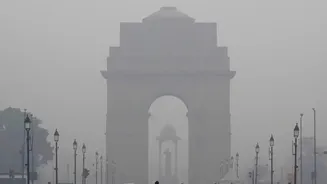
The AQI of Delhi fell into the “moderate” zone in early October 2026 after a series of relatively cleaner days and the transition was due to poorer dispersion and the end of the late September rain.The pattern is a reminder that air quality depends not only on how much pollution is emitted, but also on what the atmosphere does with it.
Is October air harmful?
An important distinction is that October itself is not the health risk. The concern is the concentration of pollutants in the air on a particular day.
According to India’s AQI classification, readings from 0-50 are considered “good”, 51-100 “satisfactory”, 101-200 “moderate”, 201-300 “poor”, 301-400 “very poor” and 401-500 “severe”.
People therefore do not need to assume that every October morning is unsafe simply because winter pollution season is approaching.
Checking the day’s AQI can be more useful than judging the air by the calendar, smell or visibility alone. This can be particularly relevant for children, older adults and people with respiratory or cardiovascular conditions, who may be more vulnerable when pollution levels rise.
What can Delhi-NCR residents do as the season changes?
The post-monsoon transition is a useful time to start paying closer attention to daily air-quality readings, particularly before planning prolonged outdoor exercise.
On days when pollution is elevated, reducing strenuous outdoor activity near busy roads and other obvious pollution sources can help lower exposure. Keeping windows open is not automatically good or bad either. Whether ventilation is useful depends on outdoor air quality at that time.
Most importantly, October’s changing air should not be viewed only as an unavoidable weather phenomenon.
Rain, wind and temperature determine how pollution behaves, but they do not create most of the emissions themselves. The sources continue to include transport, dust, industries, power generation, waste and biomass burning, among others.
That is why the first hazier days after the monsoon are more than just a sign that winter is approaching. They reveal how quickly pollution that is already being produced can become visible when the weather is no longer as effective at clearing it away.