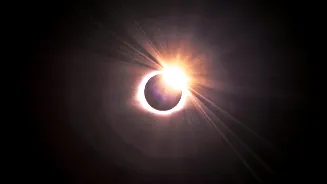








New Delhi: February 2026 will be a rare and beautiful astronomical occurrence for the skywatching community. There will be an annular solar eclipse, which
is known as a ring of fire, as the Moon passes in front of the Sun without completely covering it. Rather, there will be a bright ring of sunlight left around the Moon, and this will be one of the most dramatic scenes in the field of astronomy.
The impending eclipse has already brought about great interest, and more so to the people following the locations and how the eclipse can be viewed. There are thousands of people in India who are anxious to see whether they can see this spectacle in their cities. But, as with any solar eclipse, it is completely a matter of geography whether one is able to see it or not, and not all regions will be able to see it.
What makes this eclipse special?
The 17th of February event is categorised as an annular eclipse of the sun. It occurs when the Moon stands between the Sun and the Earth, when it is at a relatively distant moment in the orbit. The Moon is not big enough to cover the Sun entirely, as it can be seen that it is a bit smaller in the sky. This causes a glow of a ring encircling the dark centre of the Moon, a resultant effect known as the ring of fire.
In this event, the sky will not become completely dark as is the case with a total solar eclipse. There will still be daytime, but the Sun will resemble a shining halo around the Moon. This image renders annular eclipses beautiful as well as scientifically significant to the astronomers studying the outer parts of the Sun.
How the eclipse will look at its peak
The Moon will be seen nearly centred on the Sun near the peak. Its edges will be brightly seen through the ring of sunlight. The little curve observed in the eclipse videos is due to the rotation of the earth as the moon travels over the surface of the sun.
This peak age will only be seen along a small route on earth. Those on this trajectory will experience the entire annular ring of fire, whereas those that are not in the trajectory will only experience the partial eclipse.
Global timing of the February 17 eclipse
The rotation of the earth will lead to the eclipse in one corner of the world and then the other. It will begin with a partial phase at 09:56:26 UTC, and then the annular phase will begin at 11:42:54 UTC. The optimum eclipse will be at 12:12:04 UTC. The last partial phase will finish at 14:27:42 UTC, and the annular will finish at 12:41:29 UTC.
Based on the Indian Standard Time, these times correspond to approximately 3.26 pm to 7.57 pm on February 17. Nonetheless, these are the periods of other places on the eclipse track.
Will the eclipse be visible in India?
The world times will be in the late afternoon and evening in India; however, this annular solar eclipse will not be seen in New Delhi and the rest of India. The shadow of the Moon will be tracked through other parts of the globe, and India will not be included in the annular and partial rings of visibility.
Although this specific ring of fire will not be seen by Indian skywatchers, the eclipse of February 17 will be an even more followed major global astronomical phenomenon of 2026.